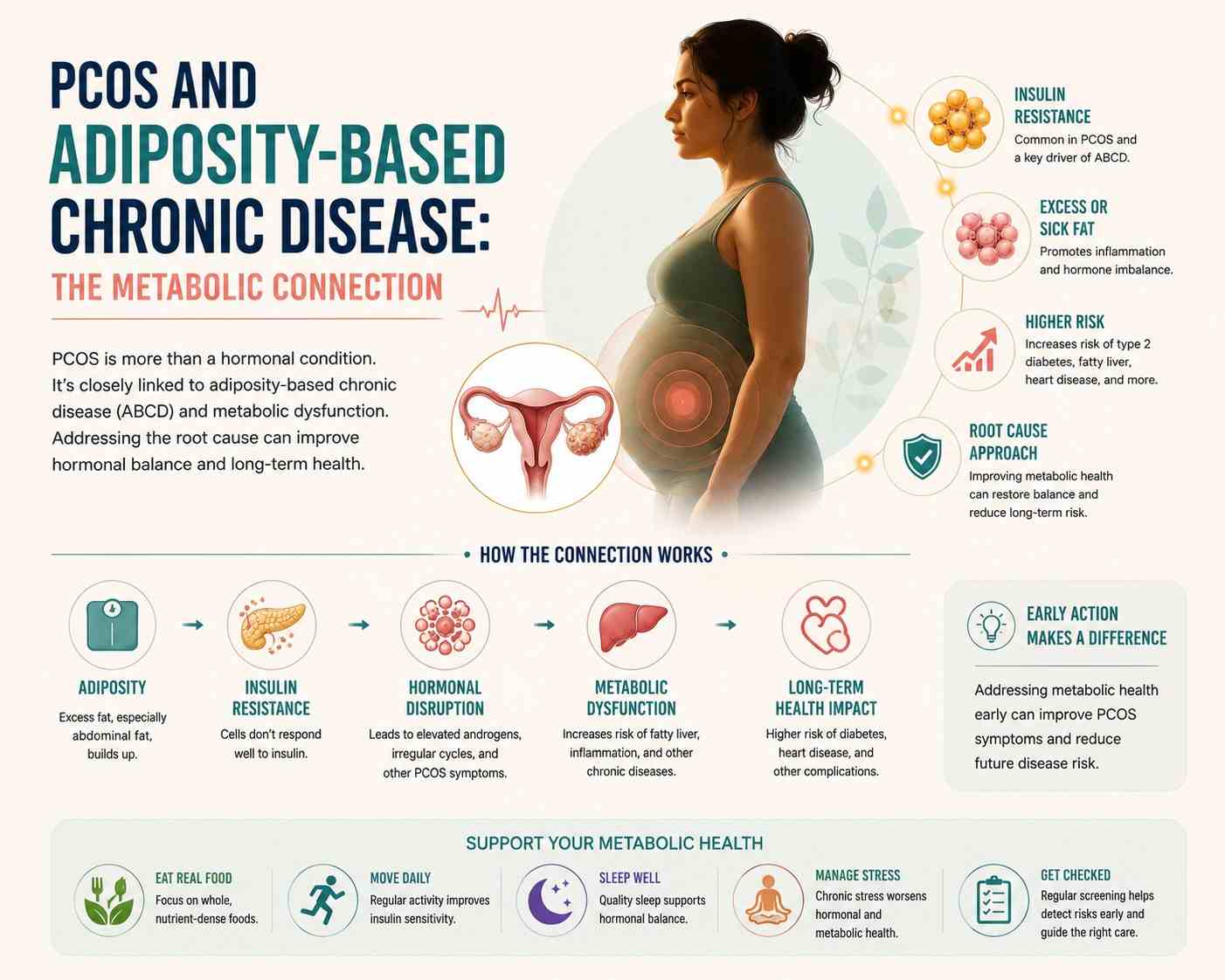
PCOS isn't just a reproductive condition. In most women who have it, insulin resistance and fat tissue dysfunction are central, not incidental, to the diagnosis.
PCOS and Adiposity-Based Chronic Disease: The Metabolic Connection
Polycystic ovary syndrome (PCOS) is typically discussed as a reproductive and hormonal condition, diagnosed by irregular periods, elevated androgens, and characteristic ovarian findings on ultrasound. What often gets less attention in that framing is how central insulin resistance and fat tissue dysfunction, the core features of Adiposity-Based Chronic Disease, are to the condition in the large majority of women who have it, not as an incidental co-occurrence, but as a driving mechanism.
How Insulin Resistance Drives PCOS Symptoms
Elevated insulin does more than affect blood sugar. In women with PCOS, chronically elevated insulin directly stimulates the ovaries to produce more androgens (male-pattern hormones like testosterone), and separately reduces the liver's production of a protein called sex hormone-binding globulin (SHBG), which normally binds and regulates androgen activity. The combined effect is more free, biologically active androgen circulating in the body, which drives many of the hallmark symptoms of PCOS: irregular or absent periods, acne, excess facial and body hair growth, and hair thinning on the scalp. This mechanism connects directly to the insulin resistance pathway covered in our article on insulin resistance symptoms.
Why This Happens Even in Women Who Aren't Overweight
A common misconception is that PCOS-related insulin resistance only affects women with obesity. In reality, a substantial proportion of women with PCOS who are not overweight by BMI still show meaningful insulin resistance on testing, sometimes described as "lean PCOS." This is consistent with the broader ABCD principle that fat tissue dysfunction and its downstream metabolic effects are not reliably predicted by BMI alone, covered in our article on how ABCD differs from a BMI-based obesity diagnosis.
The Cycle Between PCOS and Weight
The relationship runs in both directions, which is part of what makes PCOS particularly frustrating to manage. Insulin resistance promotes fat storage, particularly visceral fat, and makes weight loss more difficult through the same mechanisms covered in our article on insulin resistance treatment. At the same time, increasing visceral fat further worsens insulin resistance, creating a self-reinforcing cycle. Many women with PCOS report that standard calorie-reduction approaches to weight loss are less effective for them than for peers without the condition, a pattern consistent with what's now understood about the underlying insulin resistance driving the difficulty, rather than a lack of effort or adherence.
Long-Term Health Implications
Because insulin resistance is central to PCOS, women with the condition face meaningfully elevated long-term risk of type 2 diabetes, dyslipidemia, and cardiovascular disease, the same complications tracked throughout ABCD staging. This is why a PCOS diagnosis should reasonably prompt the same expanded metabolic evaluation used in ABCD assessment, including fasting insulin and HOMA-IR, lipid panel, and waist circumference, rather than a narrower focus limited to reproductive hormones alone.
Treatment Overlap Between PCOS and ABCD
Because the two conditions share a common driver, treatment approaches overlap substantially. The diet principles covered in our article on diet for ABCD, particularly reducing refined carbohydrate and prioritising protein and fibre, along with resistance training as covered in exercise for ABCD patients, directly target the insulin resistance underlying both conditions. Medications such as metformin, and in some cases GLP-1 medications, are used in both PCOS and broader ABCD management for the same underlying reason: improving insulin sensitivity.
This overlap is exactly why women with PCOS benefit from an evaluation that considers the full metabolic picture, not just reproductive symptoms in isolation, an approach central to how ABCD is assessed at ABCD Health.
Fertility Implications
For women with PCOS trying to conceive, the insulin resistance and metabolic dysfunction described above have direct fertility implications beyond the well-known effect on ovulation. Elevated insulin and androgens can interfere with normal follicle development, and higher BMI combined with insulin resistance is associated with lower response rates to fertility treatments including ovulation induction and IVF. This is one of the strongest practical arguments for addressing the metabolic side of PCOS proactively, rather than moving straight to fertility-specific interventions without first improving the underlying insulin resistance: in many cases, meaningful improvement in insulin sensitivity through the diet and exercise changes covered in our related articles restores regular ovulation on its own, sometimes avoiding or improving the odds of success with more intensive fertility treatment.
This doesn't mean every woman with PCOS needs to delay fertility treatment while working on metabolic health, that decision depends on age, how long a couple has been trying to conceive, and other individual factors, but it does mean the metabolic and reproductive sides of PCOS are worth addressing together rather than treating fertility in isolation from the insulin resistance driving much of the underlying dysfunction.
Frequently Asked Questions (FAQs)
1. Can hormonal birth control address the underlying insulin resistance?
Birth control can help manage cycle irregularity and some symptoms, but it does not directly treat insulin resistance, which generally requires the diet, exercise, and sometimes medication approaches described above.
2. Does treating insulin resistance help with PCOS-related acne?
Often, yes, since acne related to PCOS is frequently driven by elevated androgens, which themselves are driven by elevated insulin, so improving insulin sensitivity can meaningfully improve skin symptoms.
3. Can PCOS be misdiagnosed as simple weight gain?
Yes, particularly when reproductive symptoms are mild or absent, PCOS-related metabolic changes can be mistaken for unrelated weight gain, which is why a full hormonal and metabolic evaluation matters when PCOS is suspected.
4. Can diet alone regulate periods in PCOS?
For some women, improving insulin sensitivity through diet and exercise is sufficient to restore more regular cycles, though others require medical therapy alongside lifestyle change.
5. Does PCOS increase risk even after menopause?
Yes, the elevated cardiometabolic risk associated with PCOS-related insulin resistance generally persists beyond the reproductive years, making ongoing metabolic monitoring relevant throughout life.
6. Is insulin resistance present in all women with PCOS?
It's present in a large majority of women with PCOS, including many who are not overweight, though the exact proportion varies by diagnostic criteria and population studied.
7. Can PCOS symptoms improve without weight loss?
Yes, to some degree. Improving insulin sensitivity through diet and exercise changes can improve PCOS symptoms even before significant weight loss occurs, since insulin resistance itself, not just body weight, drives many symptoms.
8. Why is weight loss often harder for women with PCOS?
Insulin resistance promotes fat storage and can blunt the effectiveness of standard calorie-reduction approaches, which is why a more targeted, insulin-resistance-focused approach is often more effective than generic dieting.
9. Should women with PCOS be screened for diabetes risk?
Yes. Given the central role of insulin resistance in PCOS, screening with fasting glucose, HbA1c, and ideally fasting insulin is a reasonable and often recommended part of PCOS management.
10. Can PCOS occur without any weight gain?
Yes, so-called 'lean PCOS' is a recognised presentation, where insulin resistance and PCOS symptoms are present despite a normal BMI, reinforcing that PCOS is not solely a condition of excess weight.
11. Do PCOS and ABCD require completely different treatment approaches?
No, there's substantial overlap, since both conditions are frequently driven by the same underlying insulin resistance, and treatment principles like diet, exercise, and in some cases medication overlap significantly between the two.
This article is for educational purposes and does not replace personalized medical advice. Please consult a qualified physician before making changes to your treatment, medication, or health screening plan.