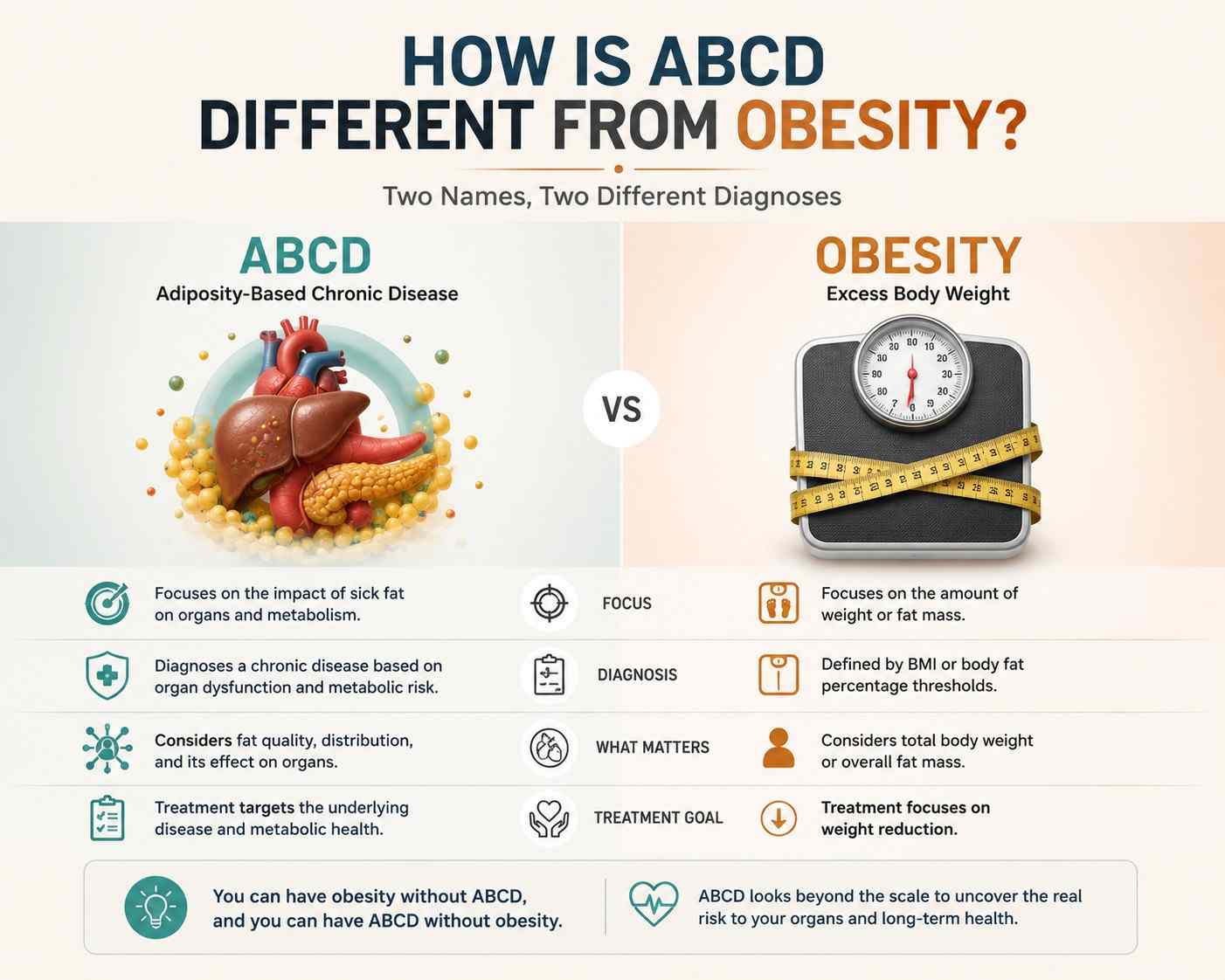
Obesity and ABCD aren't just different names for the same thing. One is based on a single number. The other is based on how your body is actually functioning.
How Is ABCD Different From Obesity? Two Names, Two Different Diagnoses
It's a reasonable question: if Adiposity-Based Chronic Disease is fundamentally about excess body fat, how is it actually different from a standard obesity diagnosis? The answer isn't semantic. ABCD and a conventional obesity diagnosis rest on genuinely different diagnostic logic, and the difference has real consequences for how treatment is planned and evaluated.
Obesity: A Diagnosis Based on a Single Number
In most conventional clinical settings, obesity is diagnosed using Body Mass Index (BMI), a calculation based solely on height and weight, with a BMI of 30 or above generally classifying someone as obese. This approach is simple and inexpensive to apply at scale, which is part of why it remains widely used. It has a well-documented limitation, however, covered in detail in our article on why BMI is not enough: it cannot distinguish between muscle and fat, cannot assess where fat is distributed in the body, and says nothing about whether that fat tissue is functioning normally or driving disease elsewhere.
ABCD: A Diagnosis Based on Function and Complications
The Adiposity-Based Chronic Disease framework, developed by the American Association of Clinical Endocrinology, deliberately moves away from a single-number diagnosis. Instead, ABCD is diagnosed and staged based on two things together: the presence of excess or abnormally distributed adiposity (using waist circumference and body composition alongside BMI), and evidence of weight-related complications, ranging from insulin resistance and dyslipidemia to established conditions like type 2 diabetes, fatty liver disease, or sleep apnea. Our article on the four stages of ABCD covers this staging system in detail.
A Concrete Example of the Difference
Consider two individuals, both with a BMI of 31. The first has a waist circumference within a healthy range for their build, normal blood pressure, normal fasting glucose and insulin, and a normal lipid profile: by BMI alone, this person is classified as obese, but by ABCD staging, they may sit at Stage 0, with adiposity present but no evidence of fat tissue dysfunction or complications. The second person, with the identical BMI of 31, has an elevated waist circumference, mildly elevated fasting insulin, borderline high triglycerides, and early fatty liver changes on ultrasound. Under ABCD staging, this person would be classified at Stage 1 or 2, reflecting genuine disease activity that the BMI-only obesity diagnosis, identical for both people, entirely fails to capture.
Why This Distinction Matters Clinically
Treatment intensity, monitoring frequency, and the appropriateness of medical therapy (versus lifestyle intervention alone) should reasonably differ between these two people, despite their identical BMI. A diagnosis based purely on BMI risks both over-treating the first person and, more concerningly, under-treating or delaying appropriate care for the second, precisely because the number that triggered their obesity diagnosis looked the same. This is a central argument made by clinical bodies including the American Association of Clinical Endocrinology in advocating for the ABCD framework over BMI-only diagnosis, and it's covered further in our comparison of AACE and ABCD approaches.
Does This Mean BMI Is Useless?
No. BMI remains a reasonable, low-cost initial screening tool at a population level, and it correlates with health risk reasonably well across large groups of people. The issue is using it as the sole basis for an individual diagnosis or treatment decision, rather than as one data point within a fuller evaluation that includes waist circumference, metabolic testing, and a review of existing complications, exactly the more complete evaluation used throughout ABCD staging at ABCD Health.
What This Means When You Actually See a Doctor
In practical terms, this distinction should change what a thorough consultation looks like. If a physician's obesity assessment begins and ends with a height and weight measurement, it's reasonable to ask whether waist circumference, blood pressure, and a metabolic panel including fasting insulin are also being considered, particularly if you have any of the risk factors covered throughout our blog, including family history, PCOS, or unexplained fatigue. This isn't about second-guessing every clinician, most obesity care in India remains reasonably thorough, but about understanding that a diagnosis of "obese" by BMI alone is the beginning of an evaluation, not the end of one.
It's also worth knowing that a diagnosis of "overweight" or even "normal weight" by BMI doesn't rule out ABCD, and shouldn't end the conversation either if other risk factors, such as central adiposity or a family history of metabolic disease, are present. The goal of the ABCD framework, ultimately, is to make sure the diagnosis reflects what's actually happening inside the body, not just what a scale and a height measurement suggest from the outside.
Frequently Asked Questions (FAQs)
1. Will ABCD terminology eventually replace the word obesity entirely?
That shift is happening gradually within clinical and academic circles, though both terms are likely to coexist for some time as awareness of the ABCD framework continues to grow.
2. Does the ABCD framework apply differently to children or adolescents?
Paediatric obesity assessment uses different growth-based criteria, though the underlying principle of looking beyond a single number toward metabolic function is increasingly applied in paediatric care as well.
3. Which framework should I ask my doctor to use?
You don't need to specify a framework by name. Simply asking whether waist circumference and metabolic testing will be included alongside BMI is enough to prompt a more complete evaluation.
4. Is ABCD staging used outside of specialised clinics?
Awareness is growing among endocrinologists and obesity medicine specialists, though it isn't yet universal across general practice, which is part of why patient awareness of the distinction matters.
5. Is ABCD just a rebranding of obesity?
No. While both relate to excess adiposity, ABCD uses a fundamentally different diagnostic approach, based on fat tissue function and the presence of complications rather than BMI alone.
6. Can someone be obese by BMI but not have ABCD?
Yes. If waist circumference is within a healthy range and no metabolic complications are present, someone can meet the BMI threshold for obesity while sitting at ABCD Stage 0, reflecting adiposity without disease activity.
7. Can someone have ABCD without being classified as obese by BMI?
Yes. Someone with a BMI in the 'overweight' or even 'normal' range but significant visceral fat and early metabolic disturbance can still meet criteria for adiposopathy or early-stage ABCD.
8. Why did AACE create the ABCD framework instead of just using obesity?
The stated goal was to move diagnosis and treatment decisions away from a single number toward a more clinically complete picture of fat tissue function and complications, which better reflects individual risk and treatment need.
9. Is BMI still used at all in ABCD evaluation?
Yes, as one initial screening measure among several, including waist circumference and metabolic testing, rather than as the sole basis for diagnosis or treatment planning.
10. Does insurance or medical documentation recognize ABCD as a diagnosis?
Recognition varies by region and system. Regardless of formal coding, the clinical framework itself provides a more complete picture for treatment planning, which is the primary reason it's used in practice.
This article is for educational purposes and does not replace personalized medical advice. Please consult a qualified physician before making changes to your treatment, medication, or health screening plan.