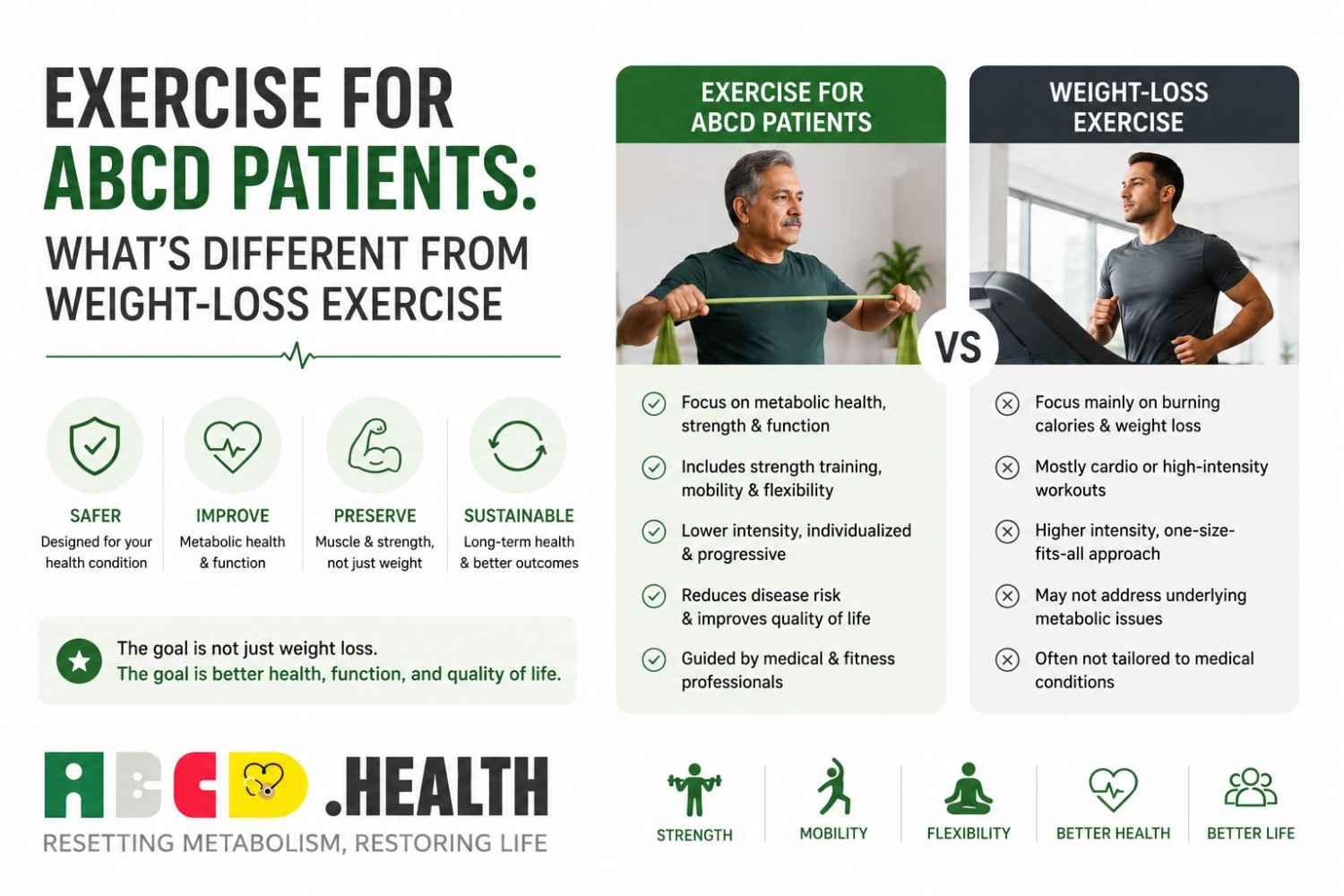
If your exercise plan is built entirely around cardio and calorie burn, it's missing the piece that actually reverses the disease process behind ABCD.
Exercise for ABCD Patients: What's Different From Weight-Loss Exercise
Most people associate exercise for weight loss with cardio: running, cycling, long sessions on a treadmill aimed at maximising calorie burn. For Adiposity-Based Chronic Disease specifically, this framing misses the more clinically important tool. Exercise for ABCD is not primarily about burning calories during the workout; it's about improving the function of muscle and fat tissue in ways that directly reverse the disease process, and resistance training does this more effectively than cardio alone.
Why Muscle Tissue Matters So Much in ABCD
Skeletal muscle is the largest site of glucose disposal in the body, meaning the majority of the glucose from a meal is taken up and used by muscle tissue, not fat or liver. In insulin resistance, one of the core features of ABCD covered in our article on insulin resistance symptoms, this glucose uptake becomes impaired. Resistance training directly improves this by increasing muscle's sensitivity to insulin and by increasing the amount of metabolically active muscle tissue available to take up glucose, an effect that is distinct from, and complementary to, the calorie-burning effect of cardio exercise.
What the Evidence Shows
Research comparing resistance training, aerobic exercise, and combined programmes in people with obesity and insulin resistance consistently finds that resistance training produces meaningfully better preservation, and often improvement, of lean muscle mass during a fat-loss phase compared to aerobic exercise alone. Combined programmes, using both resistance and aerobic training, tend to produce the best overall outcomes for both fat loss and metabolic markers, which is why treatment plans at ABCD Health are built around both, rather than cardio in isolation.
A Practical Framework
Resistance Training: 2–4 Sessions per Week
Sessions should target all major muscle groups, using either bodyweight, resistance bands, or weights depending on fitness level and any existing joint or mobility limitations, which are common in more advanced ABCD given mechanical loading on joints. Beginning under supervision, particularly for anyone with existing joint disease or very low baseline fitness, reduces injury risk and improves long-term adherence.
Aerobic Activity: 150+ Minutes per Week of Moderate Intensity
This aligns with general physical activity guidelines from bodies including the CDC, and can include brisk walking, cycling, or swimming. For ABCD specifically, aerobic activity supports cardiovascular health and adds to the total energy deficit, complementing rather than replacing the muscle-preserving effect of resistance work.
Daily Movement: Post-Meal Walking
A short walk, even 10–15 minutes, after meals has a measurable, immediate effect on post-meal glucose response, making it a low-effort, high-value addition alongside structured exercise sessions rather than a replacement for them.
Special Considerations for More Advanced ABCD
At Stage 2 or 3, existing complications change what's appropriate. Significant joint disease may require starting with low-impact or water-based exercise. Cardiovascular disease may require a supervised, graded exercise programme rather than an unsupervised start. Severe sleep apnea, covered in our related work on ABCD complications, can affect exercise tolerance and recovery, and should be addressed alongside, not after, starting an exercise programme. This is precisely why exercise prescription in ABCD should come from a clinical evaluation rather than a generic fitness plan.
Consistency Over Intensity
The research is consistent that adherence over months matters more for ABCD reversal than the intensity of any single session. A realistic, sustainable programme that's actually followed for six months will outperform an aggressive programme abandoned after three weeks, which is why exercise plans at ABCD Health are built around what a specific patient can realistically sustain, factoring in their existing complications, fitness level, and daily schedule.
Getting Started Safely
For anyone new to structured exercise, or returning after a long gap, a few practical steps reduce injury risk and improve the odds of sticking with the programme. A basic medical clearance, particularly for anyone with existing cardiovascular risk factors, joint disease, or a BMI in the higher range, is a reasonable first step before beginning a more intensive programme. Starting with two shorter sessions a week rather than an ambitious five-day plan tends to produce better long-term adherence, since the goal in the first month is establishing the habit, not maximising results immediately.
Working with a trainer or physiotherapist familiar with exercise prescription for people with obesity-related joint concerns, at least for the first several weeks, helps ensure movements are performed with proper form and appropriate loading, particularly important for anyone with existing knee, hip, or lower back discomfort related to mechanical loading from excess weight. As strength, mobility, and confidence improve, session frequency and intensity can be increased gradually, following the general principle of progressive overload that underlies effective resistance training programming at any fitness level.
Frequently Asked Questions (FAQs)
1. What if I have very limited time each week to exercise?
Even two focused 20-30 minute resistance sessions per week provide meaningful benefit over no structured exercise at all, and can be built on gradually as time allows.
2. Can exercise alone reverse ABCD without dietary change?
Exercise provides substantial independent benefit for insulin sensitivity, but combining it with dietary change generally produces meaningfully better and faster results than exercise alone.
3. Is walking alone ever enough for ABCD treatment?
Walking provides real benefit, but combining it with structured resistance training generally produces better outcomes for muscle preservation and insulin sensitivity than walking alone.
4. Do I need a gym membership to follow this approach?
No, bodyweight exercises, resistance bands, and home-based routines can effectively build the strength this article describes, particularly when starting out.
5. How long before I should expect to see results?
Early improvements in energy and strength are often noticeable within a few weeks, while measurable metabolic improvements typically take 8-12 weeks of consistent training.
6. Is resistance training really more important than cardio for ABCD?
Both play complementary roles, but resistance training addresses muscle mass and insulin sensitivity in a way cardio alone doesn't, which is why it's considered central rather than optional in ABCD treatment.
7. How many days a week should someone with ABCD exercise?
A reasonable general target is 2-4 resistance training sessions plus 150+ minutes of moderate aerobic activity per week, though this should be adjusted based on individual fitness level and existing complications.
8. Can someone with joint disease from ABCD still do resistance training?
Yes, often with modifications such as low-impact or water-based exercise, machine-based resistance training instead of free weights, and a supervised start to reduce injury risk.
9. Does walking count as exercise for ABCD treatment?
Walking, particularly after meals, provides real metabolic benefit and is a valuable addition, but it typically isn't sufficient on its own to replace structured resistance training for muscle preservation and insulin sensitivity improvement.
10. How soon can exercise improve insulin resistance?
Measurable improvements in insulin sensitivity from regular exercise, particularly resistance training, are often seen within 8-12 weeks of consistent training.
11. Should exercise start before or after dietary changes in ABCD treatment?
Ideally both begin together as part of an integrated plan, since diet and exercise address complementary aspects of ABCD and work better in combination than either alone.
This article is for educational purposes and does not replace personalized medical advice. Please consult a qualified physician before making changes to your treatment, medication, or health screening plan.