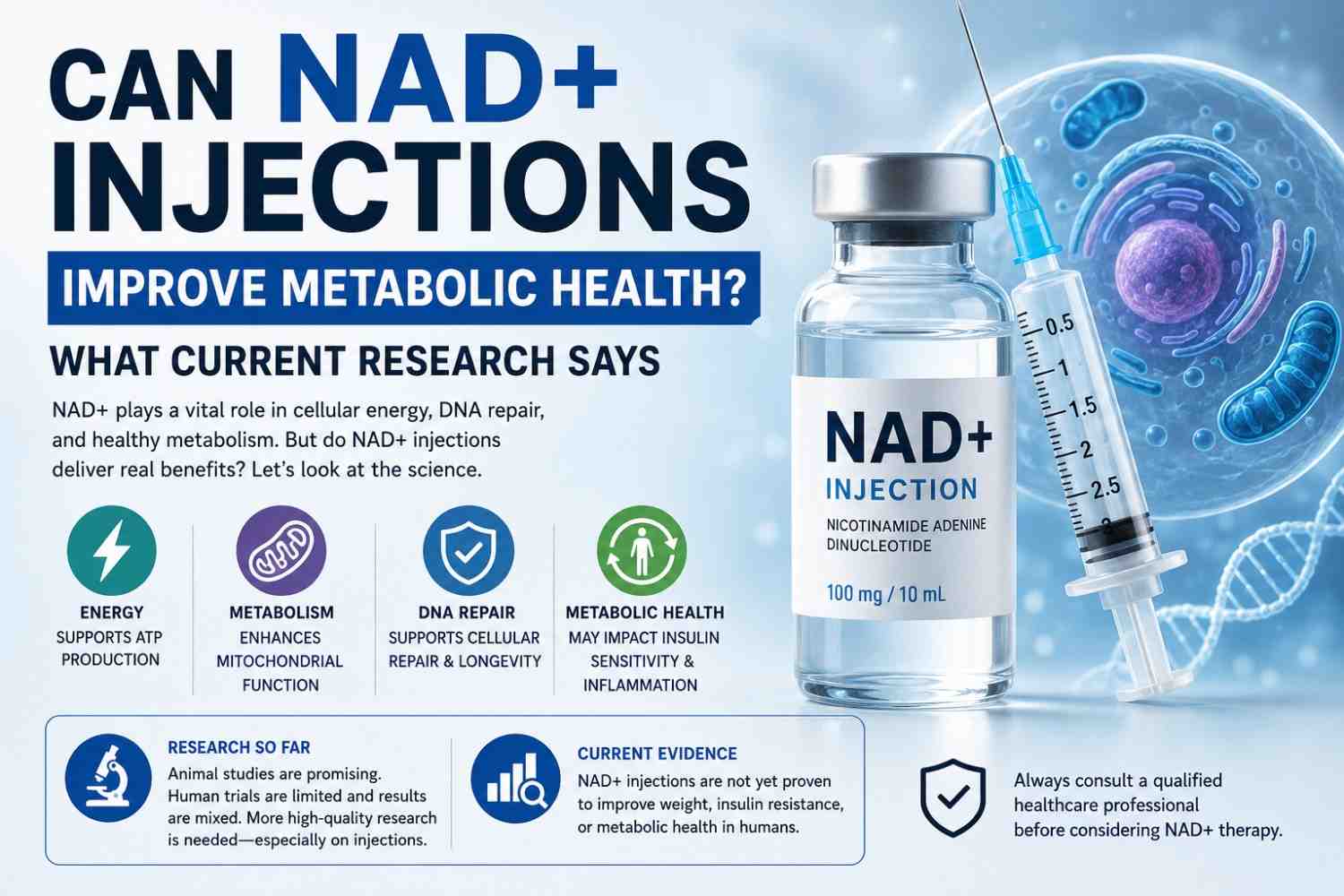
Discover what current research says about NAD+ injections, metabolic health, obesity, insulin resistance, and whether the science supports today's wellness claims.
Can NAD+ Injections Improve Metabolic Health? What Current Research Says
NAD+ injections have rapidly gained popularity across wellness clinics, longevity centers, and social media. They are often promoted as treatments that can boost energy, improve metabolism, slow aging, and even assist with weight loss. While these claims sound promising, an important question remains: what does the scientific evidence actually say?
Researchers have been studying Nicotinamide Adenine Dinucleotide (NAD+) for decades because it plays a fundamental role in cellular energy production and metabolic function. However, understanding the biological importance of NAD+ is very different from proving that NAD+ injections provide meaningful health benefits in humans.
This article reviews the current scientific evidence surrounding NAD+ injections, explains how they relate to metabolic health, and discusses whether they may have a future role in managing obesity and insulin resistance.
What Is NAD+?
Nicotinamide Adenine Dinucleotide (NAD+) is a naturally occurring coenzyme found in every living cell. It is essential for hundreds of biochemical reactions that keep our bodies functioning properly. Every time your cells convert nutrients into usable energy, NAD+ participates in the process.
Scientists consider NAD+ one of the most important molecules involved in:
Cellular energy production (ATP synthesis)
Mitochondrial function
DNA repair
Cellular aging
Oxidative stress regulation
Inflammation control
As we age, NAD+ levels naturally decline. Lower NAD+ concentrations have also been observed in several chronic conditions, including obesity, type 2 diabetes, cardiovascular disease, and neurodegenerative disorders. This association has made NAD+ an important area of medical research.
Why Is NAD+ Being Linked to Metabolic Health?
Modern research has shown that metabolism involves much more than calorie intake and body weight. Healthy metabolism depends on efficient mitochondrial function, balanced hormone signaling, and proper cellular communication.
Since NAD+ supports all of these processes, researchers believe increasing NAD+ availability could potentially improve metabolic function. This has led scientists to investigate whether restoring NAD+ levels may benefit conditions such as obesity, insulin resistance, metabolic syndrome, and fatty liver disease.
These conditions are closely connected with the concept of Adiposity-Based Chronic Disease (ABCD), where excess or dysfunctional body fat contributes to long-term metabolic complications rather than body weight alone.
If you're unfamiliar with how excess adipose tissue affects metabolism, our article on The Science of Adipose Tissue explains why body fat functions as an active endocrine organ rather than passive energy storage.
What Have Laboratory and Animal Studies Found?
Much of the excitement surrounding NAD+ comes from laboratory and animal research. Studies in mice have demonstrated that increasing NAD+ levels may improve mitochondrial function, reduce inflammation, enhance insulin sensitivity, and decrease fat accumulation in the liver.
Researchers have also observed improvements in:
Glucose metabolism
Insulin sensitivity
Energy production
Oxidative stress
Fatty liver disease
Age-related metabolic decline
These findings have generated considerable interest because many of these biological pathways are also involved in obesity and metabolic syndrome.
However, laboratory findings do not automatically translate into successful human treatments. Many therapies that perform well in animal studies ultimately fail to demonstrate the same benefits during clinical trials involving people.
What Do Human Studies Show?
This is where the conversation becomes more nuanced.
Most published human studies have not investigated NAD+ injections directly. Instead, researchers have primarily examined oral NAD+ precursors such as Nicotinamide Riboside (NR) and Nicotinamide Mononucleotide (NMN). These compounds are converted into NAD+ inside the body.
Clinical trials consistently show that these supplements can increase NAD+ levels in humans. However, increases in NAD+ do not necessarily translate into measurable improvements in metabolic health.
Several randomized controlled trials have reported that while NAD+ precursor supplementation raises NAD+ concentrations, improvements in insulin sensitivity, body weight, energy expenditure, and glucose control remain inconsistent.
This means researchers have confirmed that boosting NAD+ is biologically possible, but they have not yet demonstrated consistent clinical benefits for obesity or metabolic disease.
What About NAD+ Injections Specifically?
Although NAD+ injections are becoming increasingly popular in wellness clinics, the current scientific evidence supporting injectable NAD+ remains surprisingly limited. Most clinics advertise benefits such as increased energy, improved metabolism, faster recovery, enhanced mental clarity, and anti-aging effects. However, these claims are largely based on biological theory, anecdotal reports, or research involving oral NAD+ precursors rather than injectable NAD+ itself.
Recent systematic reviews have highlighted an important gap in the research. While numerous studies have investigated compounds that increase NAD+ levels, very few high-quality clinical trials have evaluated intravenous (IV) or intramuscular (IM) NAD+ injections as a treatment for metabolic diseases.
This does not necessarily mean NAD+ injections are ineffective—it simply means there is currently insufficient clinical evidence to confirm many of the benefits commonly advertised.
Can NAD+ Help People With Obesity?
Obesity is associated with chronic inflammation, impaired mitochondrial function, oxidative stress, and insulin resistance. Since NAD+ participates in all of these biological pathways, researchers believe increasing NAD+ availability could theoretically improve metabolic health.
However, current human studies have not demonstrated that NAD+ injections directly cause meaningful weight loss or reverse obesity. Lifestyle interventions—including healthy nutrition, regular physical activity, quality sleep, and medical treatment when appropriate—remain the foundation of obesity management.
Our guide on Insulin Resistance Treatment explains evidence-based strategies that are currently supported by stronger clinical research.
NAD+ and Insulin Resistance
One area receiving considerable scientific attention is insulin resistance. Laboratory studies suggest NAD+ may improve insulin signaling by enhancing mitochondrial function and reducing oxidative stress. These findings are promising because insulin resistance often develops years before type 2 diabetes becomes apparent.
Despite encouraging laboratory evidence, clinical studies involving humans have produced mixed results. Some participants experienced modest metabolic improvements, while others showed little or no measurable benefit.
If you're interested in understanding how insulin resistance develops and why early detection matters, read our article on Insulin Resistance Symptoms.
Potential Side Effects of NAD+ Injections
Current evidence suggests that NAD+ therapy appears to be generally well tolerated when administered under appropriate medical supervision. However, like any medical treatment, it is not entirely free of risks.
Reported side effects include:
Pain or discomfort at the injection site
Nausea
Headache
Temporary flushing
Fatigue during infusion
Dizziness in some individuals
Long-term safety data for routine NAD+ injections remain limited because large-scale clinical trials have not yet been completed.
Who Should Be Cautious?
Individuals considering NAD+ injections should first consult a qualified healthcare professional, particularly if they have diabetes, cardiovascular disease, liver disease, kidney disease, are pregnant, or take multiple prescription medications.
Since NAD+ therapy is still an emerging area of research, individualized medical advice is essential before beginning treatment.
Final Verdict: Should You Consider NAD+ Injections?
NAD+ is undoubtedly one of the most important molecules involved in human metabolism. Decades of research have demonstrated its critical role in cellular energy production, mitochondrial function, DNA repair, and healthy aging. These biological functions explain why scientists continue to investigate whether increasing NAD+ levels could improve metabolic diseases.
However, there is an important distinction between biological potential and proven clinical benefit. At present, the strongest human evidence shows that while NAD+ precursors such as NR and NMN can increase NAD+ levels, consistent improvements in obesity, insulin resistance, and metabolic health have not yet been established. Evidence supporting injectable NAD+ is even more limited.
For individuals concerned about metabolic health, the most evidence-based approach remains maintaining a healthy diet, regular physical activity, quality sleep, stress management, and appropriate medical care. These interventions have substantially stronger scientific support than NAD+ injections alone.
If you're interested in understanding how excess body fat contributes to chronic disease, our guide on Adiposity-Based Chronic Disease explains why improving metabolic health is far more important than simply reducing body weight.
Frequently Asked Questions
1. What are NAD+ injections?
NAD+ injections deliver Nicotinamide Adenine Dinucleotide directly into the body through intramuscular or intravenous administration. They are promoted for energy, recovery, and healthy aging, although clinical evidence remains limited.
2. Do NAD+ injections help with weight loss?
Current scientific evidence does not demonstrate that NAD+ injections directly cause significant or sustained weight loss. Lifestyle interventions remain the primary treatment for obesity.
3. Can NAD+ injections improve insulin resistance?
Animal studies suggest potential benefits, but human clinical trials have produced mixed results. More high-quality research is needed before NAD+ injections can be recommended for insulin resistance.
4. Are NAD+ injections approved for anti-aging?
No. NAD+ injections are not approved as an anti-aging treatment. Many claims made by wellness clinics have not yet been confirmed through large randomized clinical trials.
5. Are NAD+ injections safe?
Short-term use appears to be generally well tolerated under medical supervision, but long-term safety data are still limited.
6. How are NAD+ injections different from NR and NMN supplements?
NR and NMN are NAD+ precursors that the body converts into NAD+. Most human research has focused on these supplements rather than injectable NAD+.
7. Should people with obesity consider NAD+ injections?
At present, there is insufficient clinical evidence to recommend NAD+ injections as a standard treatment for obesity. Individuals should consult qualified healthcare professionals and prioritize evidence-based therapies.