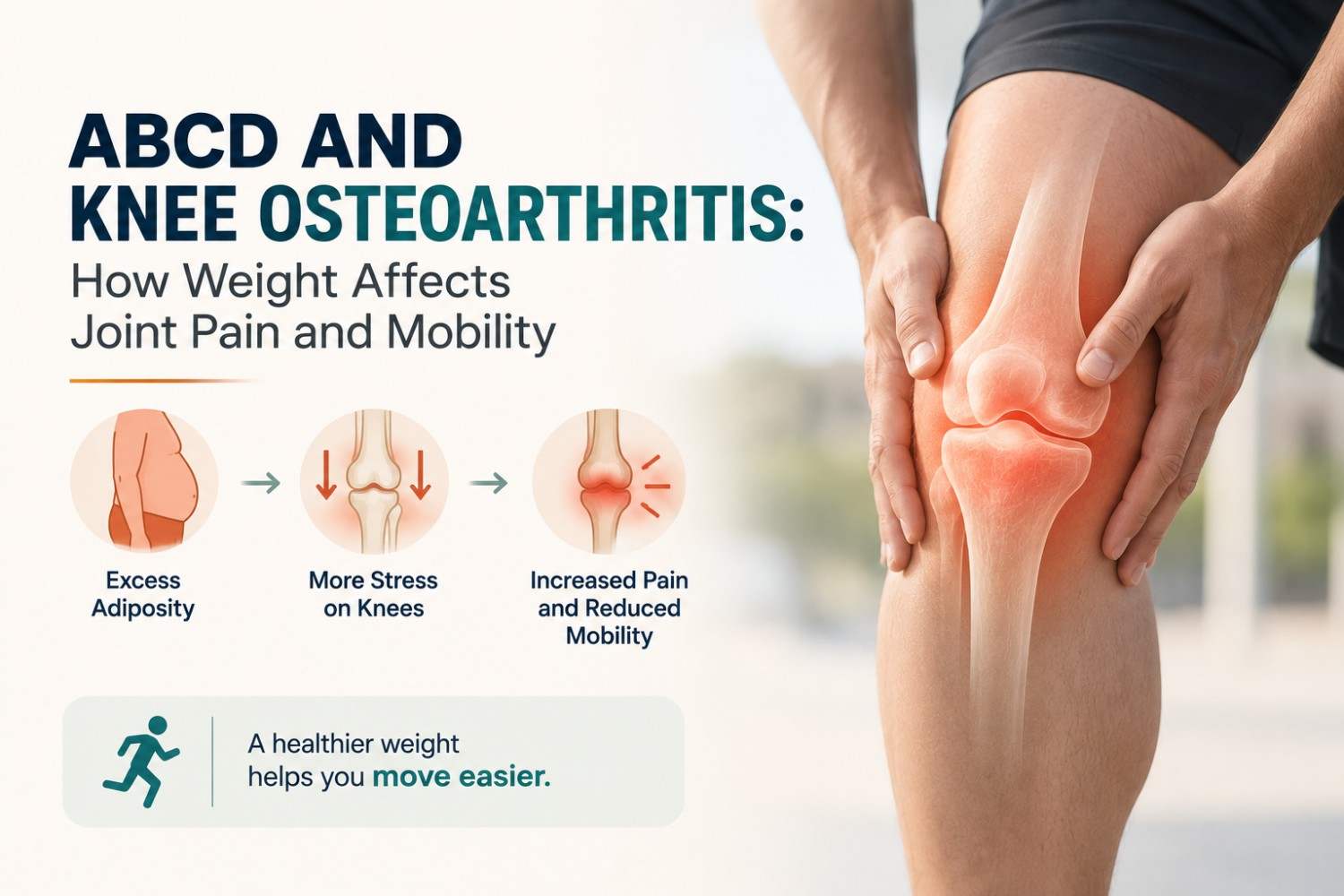
ABCD and Knee Osteoarthritis: How Weight Affects Joint Pain and Mobility is an important question because adiposity-based chronic disease is assessed by health impact, not body size alone.
ABCD and Knee Osteoarthritis: Why Excess Weight Affects Joints More Than Mechanically
The connection between excess body weight and knee osteoarthritis is usually explained purely in mechanical terms, more weight means more load on the joints, and therefore more wear over time. That mechanical explanation is real, but it is incomplete. Adiposity-Based Chronic Disease research shows that fat tissue itself actively contributes to joint damage through inflammatory pathways, independent of mechanical load alone, which changes how the relationship between weight and joint health should be understood.
The Mechanical Contribution, and Its Limits as a Full Explanation
Additional body weight does increase the load transmitted through weight-bearing joints, particularly the knees, during walking and daily activity, and this mechanical effect genuinely contributes to cartilage wear over time. However, this explanation alone does not account for the fact that osteoarthritis rates are also elevated in non-weight-bearing joints, such as the hands, among people with obesity, a pattern that mechanical loading alone cannot explain.
The Inflammatory Contribution From Fat Tissue
Visceral and other fat tissue actively secretes inflammatory signalling molecules, called adipokines, that circulate throughout the body and can directly affect joint tissue, promoting cartilage breakdown and inflammation within the joint itself, independent of mechanical load. This inflammatory pathway is part of why osteoarthritis risk is elevated even in joints that carry no additional weight, reinforcing that adiposity affects joints through more than mechanics alone.
Why This Matters for Treatment
If excess weight affected joints purely mechanically, weight loss would help only by reducing load on weight-bearing joints. Because there is also a significant inflammatory contribution, weight loss and improved insulin sensitivity can meaningfully reduce osteoarthritis symptoms and progression through both mechanisms simultaneously, mechanical unloading and reduced systemic inflammation, which is part of why weight management is such a consistently recommended component of osteoarthritis treatment.
Insulin Resistance's Specific Role
Insulin resistance itself, independent of weight, is associated with a more inflammatory internal environment that can accelerate cartilage breakdown, connecting knee osteoarthritis directly to the broader ABCD framework rather than treating it as a purely orthopedic, unrelated condition. This is covered further in our article on insulin resistance symptoms.
Common Symptoms of Knee Osteoarthritis
Pain that worsens with activity and improves with rest in earlier stages, morning stiffness that improves within about thirty minutes of movement, a grinding or crackling sensation with movement, and gradually reducing range of motion are all common presenting symptoms, typically developing gradually over months to years rather than appearing suddenly.
An Integrated Approach to Treatment
Managing knee osteoarthritis in the context of ABCD benefits from an integrated approach: weight loss and improved insulin sensitivity through diet, covered in our article on diet for ABCD, alongside appropriate low-impact exercise that strengthens supporting muscles without excessive joint stress, covered in exercise for ABCD patients. This dual approach addresses both the mechanical and inflammatory contributors simultaneously, rather than treating the joint in isolation from the broader metabolic picture.
When to Consider Further Orthopedic Evaluation
Persistent pain not responding to weight management and appropriate exercise, significant functional limitation, or advanced changes on imaging may warrant orthopedic evaluation for additional treatments, ranging from injection therapy to, in more advanced cases, joint replacement surgery, considered alongside continued metabolic management rather than as an alternative to it.
Why Addressing Both Together Matters
Treating knee osteoarthritis without addressing underlying insulin resistance and adiposity may provide symptomatic relief but leaves the inflammatory driver of joint damage unaddressed, potentially limiting how much improvement is achievable. A combined approach, addressing both the joint directly and the broader metabolic dysfunction, tends to produce more complete, longer-lasting improvement.
Discuss Knee Osteoarthritis and Metabolic Health
Frequently Asked Questions (FAQs)
1. Does weight loss always improve knee osteoarthritis symptoms?
Many people experience meaningful symptom improvement with weight loss, through both reduced joint load and reduced systemic inflammation, though the degree of benefit varies by individual and disease severity.
2. Can knee osteoarthritis occur in people who are not overweight?
Yes, other factors including injury history, joint alignment, and genetics also contribute to osteoarthritis risk independent of weight.
3. Why does osteoarthritis affect hand joints in people with obesity if it's not weight-bearing?
This pattern supports the inflammatory pathway, since fat tissue's inflammatory signalling can affect joints regardless of whether they bear body weight directly.
4. What exercise is safe for someone with knee osteoarthritis?
Low-impact activities like swimming, cycling, and specific strengthening exercises are generally well tolerated and recommended, while high-impact activities may need modification.
5. Can insulin resistance be treated to help joint symptoms even without significant weight loss?
Improving insulin sensitivity through diet and exercise can provide some anti-inflammatory benefit even before substantial weight loss occurs, contributing to symptom improvement.
6. When should surgery be considered for knee osteoarthritis?
Generally when conservative measures, weight management, exercise, and medical therapy, have not provided adequate relief and function is significantly limited, a decision made with an orthopedic specialist.
7. Is knee pain in someone with ABCD always due to osteoarthritis?
Not necessarily; a proper clinical evaluation is needed to distinguish osteoarthritis from other possible causes of knee pain.
This article is for educational purposes and does not replace personalized medical advice. Please consult a qualified physician before making changes to your treatment, medication, or health screening plan.