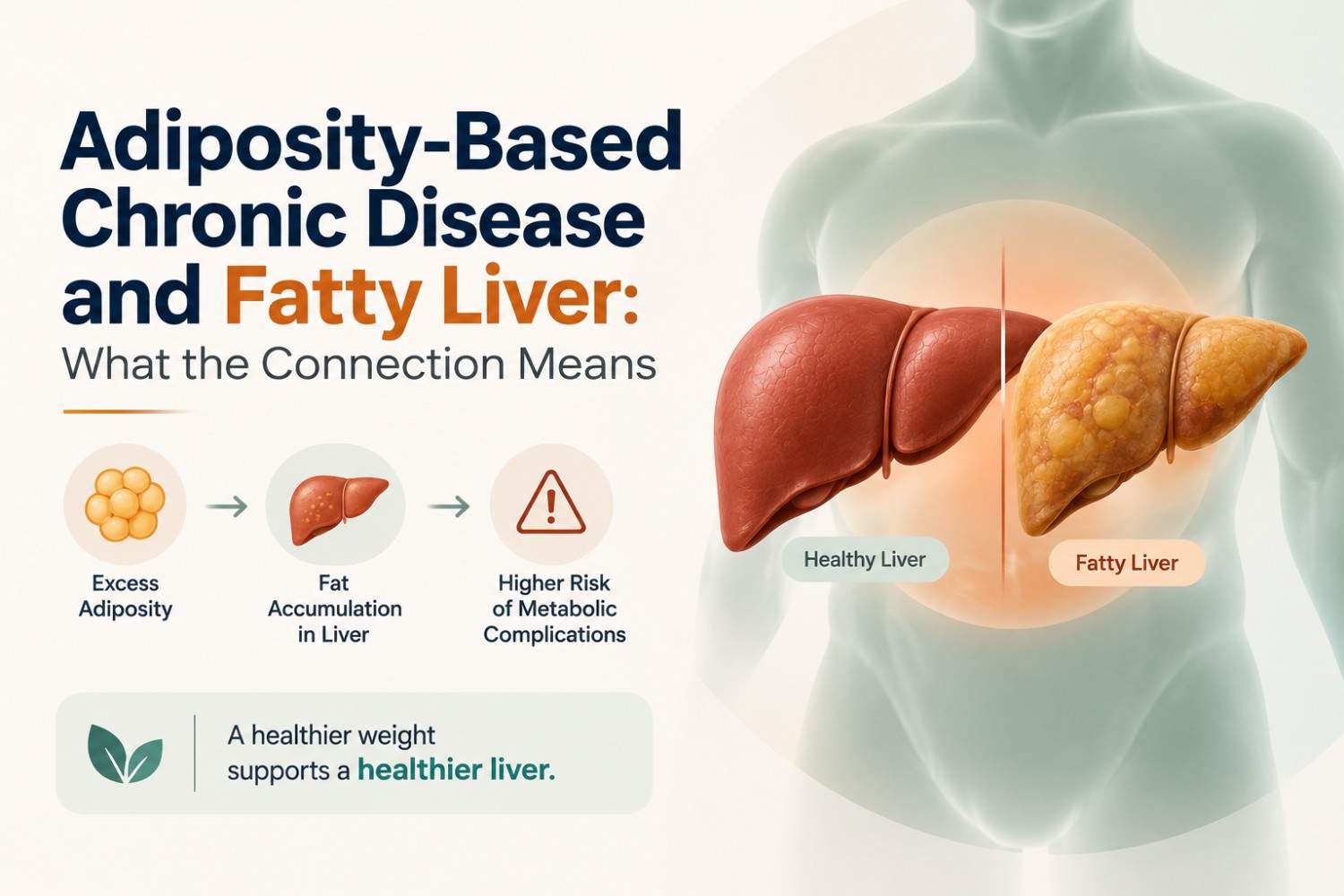
Adiposity-Based Chronic Disease and Fatty Liver: What the Connection Means is an important question because adiposity-based chronic disease is assessed by health impact, not body size alone.
ABCD and Fatty Liver Disease: A Connection That Often Goes Unnoticed
Non-alcoholic fatty liver disease has become one of the most common liver conditions worldwide, and it is closely, mechanistically linked to Adiposity-Based Chronic Disease, sharing the same underlying driver of insulin resistance. Because fatty liver disease is frequently silent, without symptoms until it has progressed significantly, understanding this connection matters for anyone already identified as having ABCD or its risk factors.
How Insulin Resistance Drives Fatty Liver Disease
Elevated insulin promotes fat storage not only in typical adipose tissue but also within the liver itself. Over time, this can lead to a build-up of fat in liver cells, the defining feature of fatty liver disease, and in some cases progress to inflammation and scarring if left unaddressed. This mechanism connects directly to the insulin resistance pathway covered in our article on insulin resistance symptoms.
Why Fatty Liver Disease Often Goes Undetected
Fatty liver disease typically causes no symptoms in its earlier stages, meaning most people are unaware they have it until it is identified incidentally, often through an ultrasound performed for an unrelated reason, or through elevated liver enzymes noticed on routine blood work. This silent progression is part of why proactive screening in at-risk individuals matters considerably more than waiting for symptoms to prompt evaluation.
Who Is at Higher Risk
People with insulin resistance, type 2 diabetes, obesity by BMI or elevated waist circumference, PCOS, or elevated triglycerides are all at increased risk of fatty liver disease, largely because these conditions share the same underlying metabolic dysfunction. Importantly, fatty liver disease can also occur in people who are not overweight by standard BMI measures, particularly when insulin resistance is present despite a normal weight.
How Fatty Liver Disease Is Diagnosed
Liver enzyme blood tests (ALT and AST) can suggest fatty liver disease, though they are not always elevated even when fat has accumulated in the liver, making them an imperfect screening tool alone. Ultrasound imaging is a more direct way to visualise fat within the liver, and in some cases, more specialised imaging or, less commonly, a liver biopsy may be used to assess the degree of inflammation or scarring present.
The Spectrum of Fatty Liver Disease
Fatty liver disease exists on a spectrum, from simple fat accumulation without significant inflammation, to non-alcoholic steatohepatitis (NASH), which involves inflammation and a higher risk of progressing to fibrosis and, in advanced cases, cirrhosis. Understanding where an individual sits on this spectrum matters considerably for guiding how closely the condition needs to be monitored and treated.
Why Fatty Liver Disease Matters Beyond the Liver Itself
Fatty liver disease is not only a liver concern; its presence is associated with meaningfully increased cardiovascular risk, independent of other traditional risk factors, making it a marker of broader metabolic dysfunction rather than an isolated organ-specific problem. This is why fatty liver screening is considered alongside the broader ABCD complication picture rather than treated as an unrelated finding.
Treatment Overlap With ABCD
There is currently no specific medication approved solely for fatty liver disease in most cases; treatment instead focuses on addressing the underlying insulin resistance through the same interventions used for broader ABCD management, weight loss, dietary changes reducing refined carbohydrate, covered in our article on diet for ABCD, and regular exercise, covered in exercise for ABCD patients. Meaningful weight loss, generally in the range of seven to ten percent of body weight, has been shown to improve or in some cases resolve fatty liver changes.
Monitoring Progress
Periodic liver enzyme testing and, where indicated, repeat imaging can track whether lifestyle interventions are producing improvement in fatty liver disease over time, alongside the broader metabolic markers used to monitor ABCD progress overall, an evaluation approach used together at ABCD Health.
Get Screened for Fatty Liver Disease
Frequently Asked Questions (FAQs)
1. Can fatty liver disease occur without drinking alcohol?
Yes, non-alcoholic fatty liver disease is specifically defined by fat accumulation in the liver not caused by significant alcohol consumption, and is closely linked to insulin resistance instead.
2. Are normal liver enzymes enough to rule out fatty liver disease?
No, liver enzymes can remain normal even with meaningful fat accumulation in the liver, which is why imaging is often a more reliable screening tool.
3. Can fatty liver disease be reversed?
Yes, particularly in earlier stages, meaningful weight loss and improved insulin sensitivity through diet and exercise can reduce or resolve fat accumulation in the liver.
4. Is fatty liver disease dangerous if left untreated?
It can progress to inflammation, scarring, and in advanced cases cirrhosis, and is also associated with increased cardiovascular risk, making it worth addressing proactively rather than ignoring.
5. Can someone with a normal BMI have fatty liver disease?
Yes, insulin resistance can be present and drive fatty liver disease even in people who are not overweight by BMI, particularly with central adiposity.
6. How much weight loss is needed to improve fatty liver disease?
Research suggests roughly seven to ten percent of body weight loss is often associated with meaningful improvement in liver fat and, in some cases, associated inflammation.
7. Is a liver biopsy always needed to diagnose fatty liver disease?
No, ultrasound and blood tests are often sufficient for initial diagnosis; biopsy is generally reserved for cases where the degree of inflammation or scarring needs more precise assessment.
This article is for educational purposes and does not replace personalized medical advice. Please consult a qualified physician before making changes to your treatment, medication, or health screening plan.