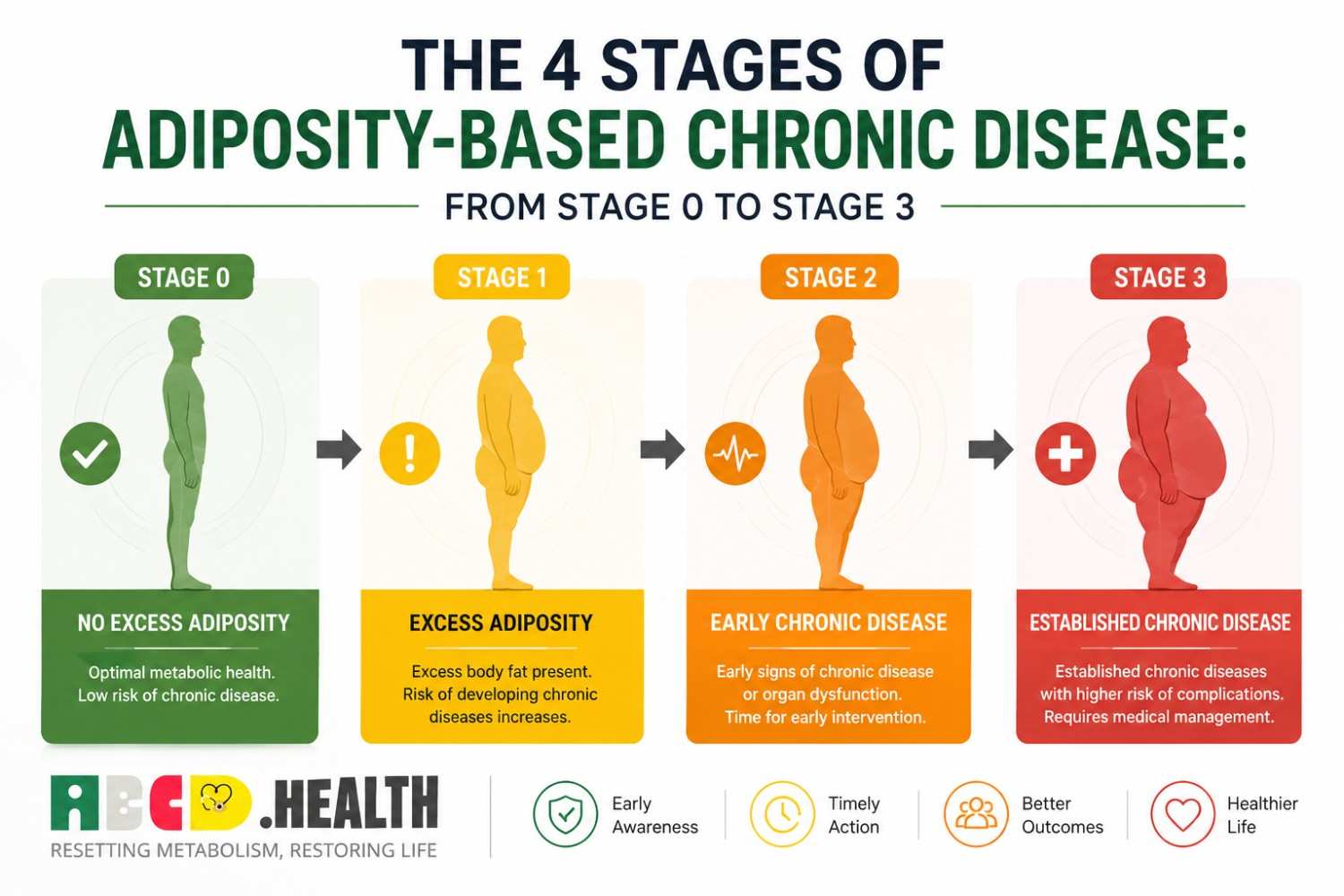
ABCD isn't a single diagnosis, it's a staged disease process. Understanding which stage you're in changes what treatment actually looks like.
The 4 Stages of Adiposity-Based Chronic Disease: From Stage 0 to Stage 3
One of the most clinically useful features of the Adiposity-Based Chronic Disease (ABCD) framework, developed by the American Association of Clinical Endocrinology (AACE), is that it doesn't treat obesity as a single, uniform diagnosis. Instead, it recognises that excess or dysfunctional body fat progresses through distinct stages, from fat tissue that is present but still functioning normally, through to fat tissue that has become actively diseased and is driving measurable complications elsewhere in the body. Knowing which stage a person is in changes what an evidence-based treatment plan should actually look like.
Stage 0: Normal Adiposity
At this stage, a person may have excess body fat by BMI or body composition measurement, but the fat tissue itself is functioning normally: it is storing energy appropriately, releasing hormones like leptin and adiponectin in a balanced way, and not yet driving inflammation or metabolic dysfunction elsewhere. Waist circumference and metabolic markers such as fasting glucose, blood pressure, and lipid panel are typically within normal ranges. This stage is where prevention has the highest leverage, since intervention here is aimed at preventing progression rather than reversing established disease.
Stage 1: Adiposopathy (Sick Fat) Without Complications
This is the stage covered in detail in our article on what is adiposopathy. Fat tissue begins to malfunction, cells become enlarged (hypertrophic), blood supply to the tissue becomes relatively inadequate, and the tissue starts producing more inflammatory signalling molecules and less of the protective hormone adiponectin. Waist circumference is typically elevated, and subtle metabolic changes, such as mildly rising triglycerides or fasting insulin, may be detectable on testing even though standard glucose and blood pressure remain within normal limits. Clinically, this is often the stage where a person "looks fine" on a basic checkup despite fat tissue dysfunction already being underway, which is precisely why waist circumference and expanded metabolic testing, covered in our piece on obesity diagnosis beyond BMI, matter at this stage specifically.
Stage 2: ABCD With Mild-to-Moderate Complications
At Stage 2, dysfunctional fat tissue has begun driving measurable disease elsewhere in the body. This typically includes prediabetes, elevated blood pressure, an abnormal lipid profile, early fatty liver changes, or mild sleep-disordered breathing. The complications at this stage are often still substantially reversible with consistent intervention, which is part of why early identification matters so much — the same degree of fat dysfunction, caught and treated at Stage 2 rather than allowed to progress to Stage 3, carries a meaningfully better long-term outlook.
Stage 3: ABCD With Severe Complications
This is the most advanced stage, where complications have progressed to established, often less easily reversible disease: type 2 diabetes, cardiovascular disease, non-alcoholic steatohepatitis (NASH), severe obstructive sleep apnea, or significant joint disease from mechanical loading. At this stage, treatment typically requires managing multiple conditions simultaneously alongside the underlying adiposity, and while meaningful improvement is still achievable, full reversal of every complication is less likely than at earlier stages.
Why Staging Changes Treatment
The AACE framework was explicitly designed to move obesity management away from BMI-only decision-making and toward a staged, complication-focused model, a distinction we cover in more depth in our comparison of AACE and ABCD frameworks. Two people with an identical BMI of 32 can sit at completely different stages: one at Stage 0 with normally functioning fat tissue and no metabolic disturbance, the other at Stage 2 with prediabetes and hypertension already present. Treating both people identically, based on BMI alone, misses the clinical reality that the second person needs more intensive intervention, and potentially different treatment tools altogether, including medication, where the first may benefit most from monitoring and lifestyle reinforcement alone.
Staging also gives both physician and patient a concrete way to track progress that isn't simply "weight up or weight down." Moving from Stage 2 back to Stage 1, with prediabetes resolving and blood pressure normalising, is a meaningful clinical outcome even if body weight hasn't changed dramatically, and it's the kind of outcome the ABCD framework is specifically built to capture.
Getting Staged
Formal ABCD staging requires a clinical evaluation that goes beyond a scale and a BMI calculation: waist circumference, blood pressure, a fasting metabolic panel including glucose and lipids, and a review of any existing complications such as sleep study results or liver enzyme tests where relevant. This is the starting point for every treatment plan at ABCD Health, and it's the reason "just lose weight" is not, on its own, a clinically complete plan for a condition that can present so differently from one person to the next.
How Physicians Actually Use Staging in Practice
In a real clinical encounter, staging shapes the entire treatment conversation rather than existing as an abstract label attached to a chart. A patient staged at Stage 0 or early Stage 1 is typically counselled toward prevention-focused lifestyle change, with monitoring at regular intervals to catch any progression early. A patient at Stage 2, with prediabetes and early fatty liver changes already present, is more likely to be offered a structured, more intensive plan, potentially including medical therapy alongside lifestyle change, because the evidence suggests waiting is more likely to allow progression to Stage 3 than to see spontaneous improvement. A patient already at Stage 3, managing type 2 diabetes and cardiovascular disease together, needs coordinated care across specialities, with the ABCD framework serving as the organising structure that connects the seemingly separate diagnoses back to their shared root cause.
This is also why re-staging matters over time. A treatment plan built for someone at Stage 2 should be reassessed and adjusted as they, hopefully, move back toward Stage 1, since the intensity of monitoring and medical therapy that was appropriate at diagnosis may no longer be necessary once complications have resolved.
Frequently Asked Questions (FAQs)
1. Can someone move backward through the ABCD stages?
Yes, this is the explicit goal of treatment. Moving from Stage 2 back to Stage 1, or Stage 1 back to Stage 0, is achievable with sustained treatment, particularly the earlier the intervention begins.
2. Is BMI used at all in ABCD staging?
BMI is used as an initial screening measure, but staging depends primarily on the presence and severity of weight-related complications, not BMI alone, which is the central distinction of the ABCD framework.
3. Can a person with a 'normal' BMI still have ABCD?
Yes. Because staging depends on fat tissue function and complications rather than BMI alone, a person with a normal BMI but significant visceral fat and early metabolic disturbance can still be staged with adiposopathy or early ABCD.
4. How is ABCD staging different from simply diagnosing obesity?
A standard obesity diagnosis based on BMI doesn't distinguish between functioning and dysfunctional fat tissue, or between someone with no complications and someone with several. ABCD staging is specifically designed to capture that distinction.
5. Who should get formally staged for ABCD?
Anyone with elevated waist circumference, a BMI in the overweight or obese range, or existing metabolic risk factors is a reasonable candidate for a full ABCD evaluation rather than a BMI-only assessment.
6. Does staging need to be repeated over time?
Yes, staging is a snapshot of current disease status, and it's typically reassessed periodically, particularly during active treatment, to confirm whether the plan is working and whether stage has improved.
This article is for educational purposes and does not replace personalized medical advice. Please consult a qualified physician before making changes to your treatment, medication, or health screening plan.