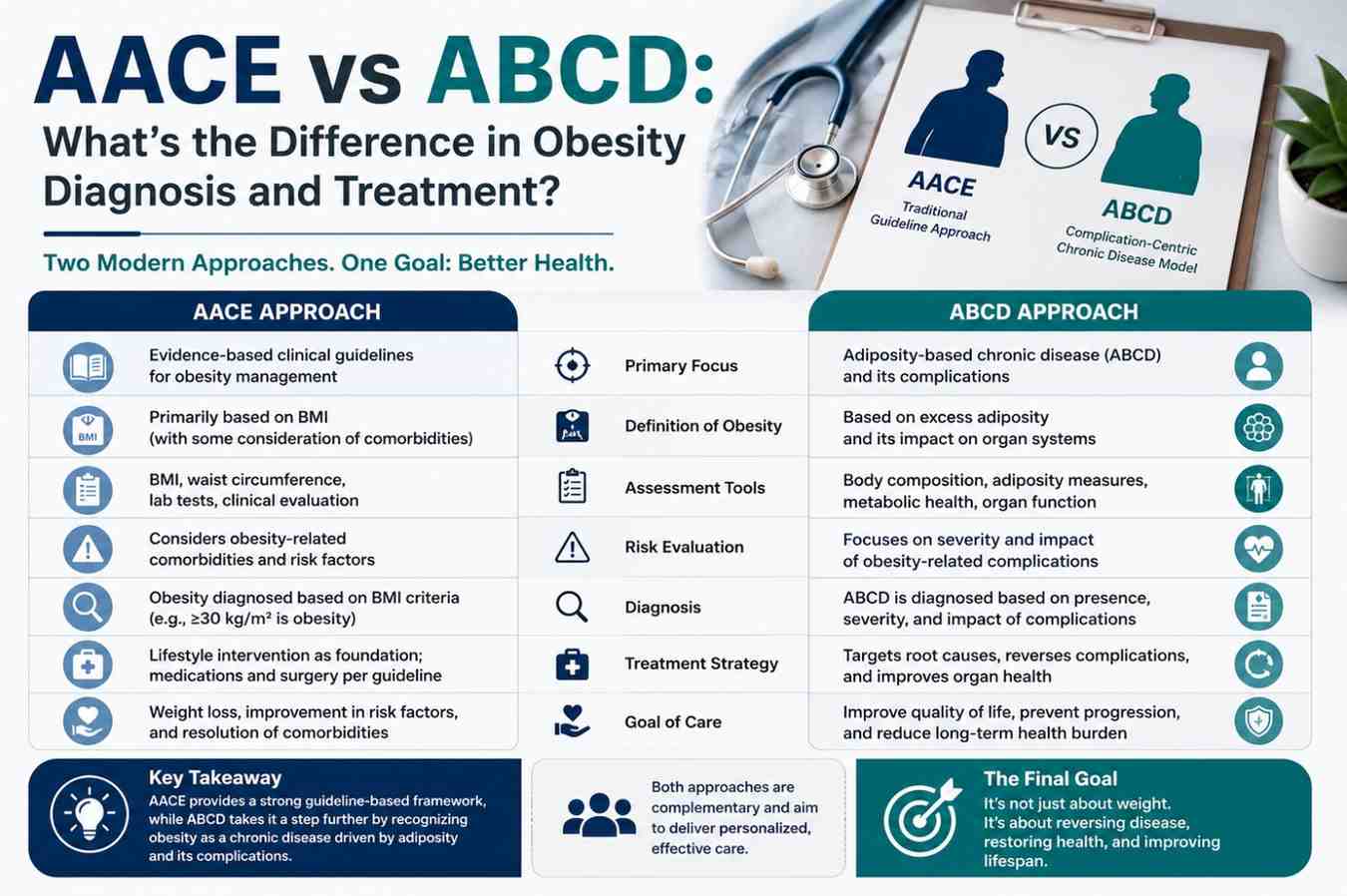
Compare AACE vs ABCD frameworks to understand modern obesity diagnosis, staging, and treatment approaches beyond BMI.
AACE vs ABCD: What’s the Difference in Obesity Diagnosis and Treatment?
Obesity care is changing rapidly, and two major frameworks are shaping how clinicians approach diagnosis and treatment today: the AACE guidelines and the adiposity-based chronic disease (ABCD) model. While both aim to improve patient outcomes, they are not identical. If you are trying to understand AACE vs ABCD, it is important to see how they differ in approach, structure, and clinical application.
This comparison is not just academic. It directly affects how patients are diagnosed, how risks are assessed, and how treatment decisions are made. Understanding the difference helps you see why modern obesity care is moving beyond simple weight-based definitions.
Two Approaches with a Shared Goal
Both AACE and ABCD recognize that obesity is a chronic disease, not just a lifestyle issue. They move away from treating weight alone and instead focus on metabolic health and complications.
However, the way they structure this understanding is different:
- AACE: A clinical guideline system designed to guide diagnosis and treatment decisions
- ABCD: A disease model that redefines obesity based on fat distribution and complications
Think of AACE as a detailed playbook and ABCD as a broader conceptual framework. If you're new to the concept, start with What is Adiposity-Based Chronic Disease?.
How Each Framework Defines Obesity
The biggest difference lies in how obesity is defined.
AACE still uses BMI as an entry point but does not rely on it alone. It combines BMI with clinical evaluation of complications such as diabetes risk, cardiovascular disease, and metabolic dysfunction.
ABCD goes a step further. It shifts the definition entirely toward adiposity, meaning body fat and its impact on health. In this model, obesity is diagnosed based on how fat affects organs and metabolic function, not just how much a person weighs.
For a detailed comparison of these concepts, see ABCD vs Traditional Obesity.
Diagnosis: Screening vs Disease Classification
In practical terms, diagnosis looks different under each system.
AACE focuses on structured clinical evaluation. It starts with BMI but then assesses complications such as insulin resistance, blood pressure, lipid levels, and waist circumference.
ABCD treats obesity as a disease spectrum. It classifies patients based on adiposity-related complications, even if their BMI is not very high. This allows earlier detection of metabolic issues.
This is why someone with a "normal" BMI but high visceral fat may still be identified as at risk under ABCD. Learn more about why BMI alone is not enough.
Staging and Risk Assessment Differences
Both systems use staging, but they apply it differently.
AACE staging focuses on the severity of complications. Patients are grouped based on whether they have mild, moderate, or severe metabolic issues.
ABCD staging is more closely tied to adiposity and its impact on the body. It emphasizes how fat distribution affects organ systems and disease progression.
The key difference is that ABCD is more centered on fat-related dysfunction, while AACE is more structured around clinical risk categories.
Treatment Approach: Structured vs Conceptual
Treatment is where these frameworks overlap the most but still show clear differences.
AACE provides step-by-step treatment guidance. It outlines when to use lifestyle changes, when to introduce medication, and when to consider advanced interventions like bariatric procedures.
ABCD, on the other hand, does not act as a strict treatment guideline. It guides clinicians to focus on reducing adiposity-related complications and improving metabolic health.
In practice, many clinicians use ABCD for understanding the disease and AACE for deciding how to treat it. Treatments such as GLP-1 therapy for ABCD are examples of this modern approach.
Why This Difference Matters in Real Life
For patients, this difference can change everything.
Under older BMI-only systems, many people were either misclassified or diagnosed too late. With AACE and ABCD approaches:
- High-risk individuals can be identified earlier
- Hidden metabolic issues are more likely to be detected
- Treatment becomes more personalized
- Focus shifts from weight loss to health improvement
This leads to better long-term outcomes and more effective care.
Where BMI Still Fits In
Despite all these changes, BMI has not disappeared. It is still used as a quick screening tool because it is simple and widely available.
However, both AACE and ABCD clearly show that BMI alone is not enough. It must be combined with other measurements such as waist circumference, metabolic markers, and clinical assessment. You may also find BMI vs Waist-to-Height Ratio helpful.
Challenges in Adopting These Frameworks
Even though these approaches are more advanced, they are not yet fully adopted everywhere.
Some of the common challenges include:
- Reliance on traditional BMI-based systems
- Lack of awareness among patients
- Limited access to detailed metabolic testing
- Time constraints in clinical settings
As awareness grows, these frameworks are expected to become more widely used.
Which One Is Better?
This is the wrong question. AACE and ABCD are not competitors; they are complementary.
ABCD provides a better understanding of what obesity really is, while AACE provides a structured way to manage it.
Using both together gives the most complete picture of a patient’s health.
Takeaway for Better Health Decisions
If you are evaluating your own health, the key lesson is simple: do not rely only on weight or BMI.
Instead, focus on:
- Waist size and fat distribution
- Blood sugar and insulin levels
- Lipid profile and blood pressure
- Overall metabolic health
These are the factors that actually determine long-term risk. If you have signs of metabolic dysfunction, read about insulin resistance symptoms and insulin resistance treatment.
Related Articles
- AACE Obesity Guidelines Explained
- What is Adiposity-Based Chronic Disease?
- ABCD vs Traditional Obesity
- Why BMI Is Not Enough
- BMI vs Waist-to-Height Ratio
- GLP-1 Treatment for ABCD
- Insulin Resistance Symptoms
- Insulin Resistance Treatment
Final Word
The comparison of AACE vs ABCD reflects a broader shift in modern medicine. Obesity is no longer seen as just excess weight but as a complex metabolic condition.
Understanding both frameworks helps you move beyond outdated thinking and toward a more accurate and practical approach to health.
The future of obesity care lies in combining structured guidelines with deeper disease understanding, and that is exactly what AACE and ABCD together offer.