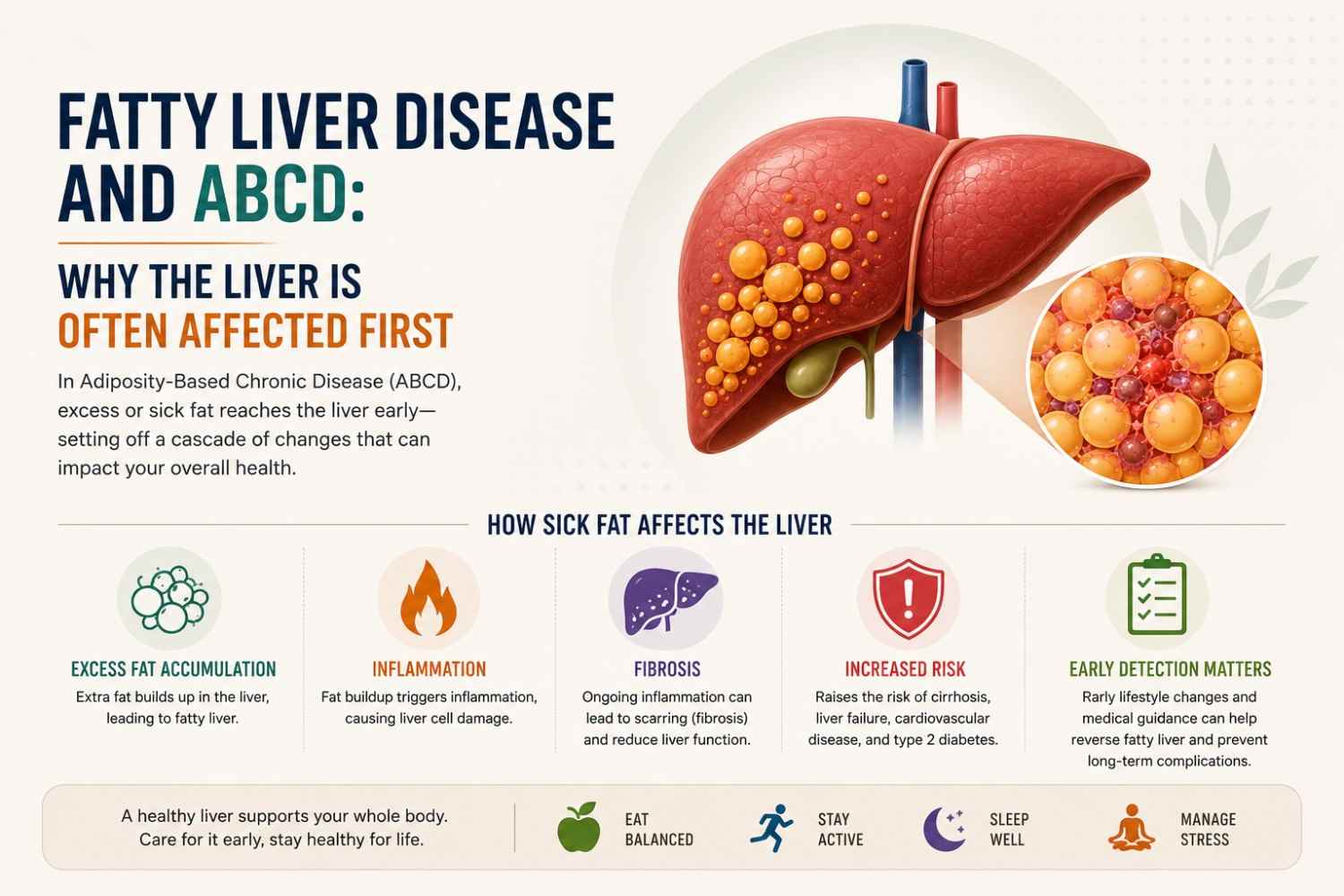
Fatty liver disease and ABCD share the same root cause, and the liver is often affected quietly, years before symptoms or standard tests reveal a problem.
Fatty Liver Disease and ABCD: Why the Liver Is Often Affected First
Non-alcoholic fatty liver disease (NAFLD), and its more advanced form, non-alcoholic steatohepatitis (NASH), are among the most common and most under-diagnosed complications of Adiposity-Based Chronic Disease. Because the liver has a substantial functional reserve and typically produces no symptoms until damage is fairly advanced, it is frequently one of the first organs meaningfully affected by dysfunctional fat tissue, quietly, without the person having any idea it's happening.
Why the Liver Is Particularly Vulnerable
Visceral fat, the fat surrounding abdominal organs, drains directly into the liver via the portal vein, giving the liver disproportionate exposure to the free fatty acids and inflammatory signals released by dysfunctional fat tissue compared to other organs. As insulin resistance develops, covered in our article on insulin resistance, the liver is pushed to produce more glucose and store more fat than it normally would, setting up the conditions for fat to accumulate within liver cells themselves, the defining feature of NAFLD.
From NAFLD to NASH: A Progression, Not a Single Event
NAFLD itself, simple fat accumulation in the liver without significant inflammation, is common and, at this stage, often reversible with treatment of the underlying ABCD. Left unaddressed, it can progress to NASH, where fat accumulation is accompanied by inflammation and early liver cell damage. Continued progression can lead to fibrosis (scarring), and in a smaller proportion of cases, cirrhosis, a serious and largely irreversible form of liver damage. This progression typically takes years, which is exactly the window during which intervention at the ABCD level, treating the underlying fat tissue dysfunction rather than waiting for liver-specific symptoms, has the greatest opportunity to prevent further damage.
Why Fatty Liver Disease Is So Often Missed
NAFLD and even early NASH typically produce no symptoms. Liver enzymes (ALT and AST) on a standard blood panel can remain within normal limits even with significant fat accumulation already present, which means a "normal" liver panel does not reliably rule out fatty liver disease. Ultrasound is more sensitive than blood tests for detecting fat in the liver, and in some cases, more advanced imaging or a specific blood-based fibrosis score is needed to assess how far the disease has progressed. This pattern of missed early detection is very similar to what we describe across our broader coverage of ABCD, where standard testing consistently misses disease that's already underway.
Who Should Be Screened
Anyone with Stage 1 ABCD (adiposopathy) or higher, given the shared root cause.
Anyone with insulin resistance, prediabetes, or type 2 diabetes, since fatty liver disease and insulin resistance are closely linked in both directions.
Anyone with central/visceral obesity, even with a normal overall BMI.
Anyone with elevated triglycerides or reduced HDL cholesterol, part of the same metabolic pattern.
Population data referenced by bodies including the National Institute of Diabetes and Digestive and Kidney Diseases suggest NAFLD prevalence is substantial among people with obesity and metabolic syndrome, reinforcing why liver screening deserves a routine place in ABCD evaluation rather than being reserved for people with specific liver symptoms.
Treating Fatty Liver Through ABCD Treatment
Because fatty liver disease and ABCD share the same underlying driver, effective treatment overlaps substantially: sustained fat loss (particularly visceral fat), improved insulin sensitivity through the diet and exercise principles covered in our related articles, and, where appropriate, medical therapy. Studies on fat loss and liver fat specifically suggest meaningful reduction in liver fat content is achievable with the same 7–10% body weight loss threshold often cited for broader metabolic improvement, reinforcing that liver health is a direct outcome of ABCD treatment, not a separate condition requiring an entirely different approach.
Non-Invasive Ways to Track Liver Health Over Time
Beyond the initial ultrasound used for detection, several non-invasive tools help track liver fat and fibrosis over the course of treatment without requiring a liver biopsy, which remains the most definitive but also most invasive diagnostic option. Blood-based fibrosis scores, calculated from routine lab values including liver enzymes, platelet count, and age, give a reasonable estimate of fibrosis risk and are often used as an initial risk-stratification tool. Transient elastography, sometimes referred to by device names such as FibroScan, is a specialised ultrasound-based technique that directly measures liver stiffness, a proxy for fibrosis, and is increasingly available at hepatology centres in major Indian cities.
For most people with early-stage NAFLD and no other risk factors, repeat ultrasound and standard liver enzyme testing every six to twelve months during active ABCD treatment is a reasonable monitoring approach, with more specialised testing reserved for those whose initial results suggest more advanced disease or who aren't showing the expected improvement despite consistent treatment. The nutritional approach that supports this, covered in our article on diet for ABCD, applies directly to liver fat reduction as well, since both respond to the same underlying improvement in insulin sensitivity.
Frequently Asked Questions (FAQs)
1. Can fatty liver disease occur alongside normal cholesterol levels?
Yes, fatty liver disease can be present even when a standard cholesterol panel looks unremarkable, which is one more reason liver-specific screening matters independently.
2. Are there specific foods that directly worsen fatty liver disease?
Sugar-sweetened beverages and foods high in fructose in particular are associated with increased liver fat accumulation, making them a reasonable specific target for reduction beyond general refined carbohydrate intake.
3. Can thin people get fatty liver disease?
Yes, so-called lean NAFLD occurs in people with normal BMI but significant visceral fat or insulin resistance, reinforcing that liver risk isn't determined by overall body weight alone.
4. Is a liver biopsy always needed to diagnose fatty liver disease?
No, ultrasound and blood-based fibrosis scores are sufficient for most initial evaluations. Biopsy is generally reserved for cases where more advanced disease is suspected and other tests are inconclusive.
5. Can fatty liver disease be present with normal liver enzyme results?
Yes, this is common. Standard liver enzymes (ALT, AST) can remain normal even with significant fat accumulation in the liver, which is why ultrasound or other imaging is more reliable for detection.
6. Is fatty liver disease reversible?
NAFLD, the earlier stage without significant inflammation, is often reversible with sustained treatment of the underlying ABCD. More advanced stages like fibrosis are less consistently reversible, which is why earlier detection matters.
7. Does alcohol need to be involved for fatty liver disease?
No. Non-alcoholic fatty liver disease (NAFLD) is specifically defined as fat accumulation in the liver not attributable to significant alcohol use, and it's closely tied to obesity, insulin resistance, and ABCD rather than alcohol consumption.
8. Who should get screened for fatty liver disease?
Anyone with ABCD Stage 1 or higher, insulin resistance, central obesity, or an abnormal lipid pattern is a reasonable candidate for screening, typically starting with a liver ultrasound.
9. How much weight loss is needed to improve fatty liver disease?
Research on liver fat specifically often cites a similar threshold to broader metabolic improvement, roughly 7-10% body weight loss, for meaningful reduction in liver fat content.
10. Can fatty liver disease progress to something more serious?
Yes, if left unaddressed, NAFLD can progress to NASH, then fibrosis, and in a smaller proportion of cases, cirrhosis, which is why early identification and treatment of the underlying ABCD matters.
This article is for educational purposes and does not replace personalized medical advice. Please consult a qualified physician before making changes to your treatment, medication, or health screening plan.