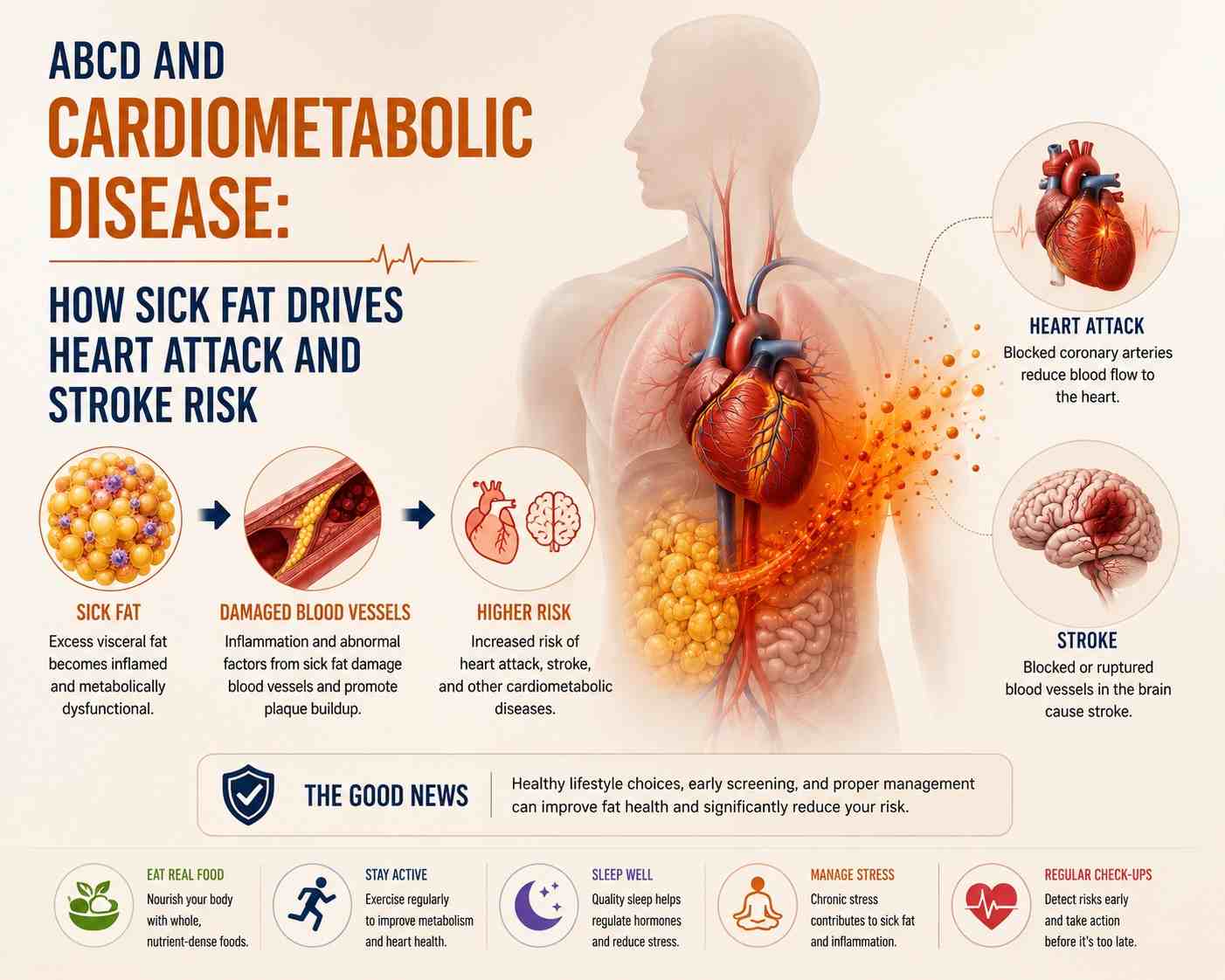
Cardiovascular disease and ABCD share the same root cause. Understanding the mechanism explains why treating 'sick fat' is also heart disease prevention.
ABCD and Cardiometabolic Disease: How Sick Fat Drives Heart Attack and Stroke Risk
Cardiovascular disease is frequently discussed as if it exists independently of obesity, connected only loosely through shared risk factors like high blood pressure or cholesterol. The Adiposity-Based Chronic Disease framework makes a more direct and, according to a growing body of research, more clinically accurate claim: dysfunctional fat tissue is not a passive bystander to cardiovascular risk. It is an active, hormonally and inflammatorily engaged organ that directly drives the biological processes behind heart attack and stroke.
Fat Tissue as an Endocrine Organ
Healthy adipose tissue, as covered in our article on the science of adipose tissue, secretes hormones and signalling molecules in a balanced way. When fat tissue becomes dysfunctional, a state called adiposopathy, this balance shifts: production of protective adiponectin falls, while production of inflammatory cytokines such as TNF-alpha and IL-6, and pro-thrombotic factors that promote blood clotting, rises. These changes don't stay contained within fat tissue; they circulate throughout the body and directly influence blood vessel health, insulin sensitivity in the liver and muscle, and clotting tendency.
The Direct Mechanistic Path to Cardiovascular Disease
1. Chronic Low-Grade Inflammation
Elevated inflammatory markers, including hs-CRP specifically, are consistently and repeatedly associated with atherosclerosis, the gradual buildup of plaque within artery walls that ultimately leads to heart attack and stroke. Dysfunctional fat tissue is one of the primary sources of this chronic inflammation.
2. Dyslipidemia
Adiposopathy is strongly linked to an atherogenic lipid pattern, including elevated triglycerides, reduced HDL cholesterol, and a shift toward smaller, denser LDL particles, precisely the pattern that drives arterial plaque formation even when total cholesterol looks unremarkable.
3. Insulin Resistance and Endothelial Dysfunction
Insulin resistance, covered in our detailed guide, impairs the normal function of the endothelium, the thin layer of cells lining blood vessels responsible for regulating vascular tone and clotting. Endothelial dysfunction is now recognised as one of the earliest measurable steps in the development of atherosclerosis, often present years before a clinical cardiovascular event.
4. Hypertension
Excess visceral fat contributes to elevated blood pressure through several mechanisms, including increased activity of the sympathetic nervous system and altered kidney sodium handling, adding a further, independent layer of cardiovascular risk.
Why This Matters for Risk Assessment
Standard cardiovascular risk calculators often rely heavily on BMI, blood pressure, and a basic lipid panel. Given the mechanisms above, per guidance summarised by organisations including the The Lancet Diabetes & Endocrinology and the National Heart, Lung, and Blood Institute, a more complete cardiometabolic risk assessment in someone with ABCD should include waist circumference, hs-CRP, a full lipid panel including triglycerides, and fasting insulin, since these markers can reveal elevated risk even when a standard calculator suggests otherwise.
What This Means for Treatment
Because the underlying driver of both ABCD and much of its associated cardiovascular risk is the same dysfunctional fat tissue, treating ABCD directly, through the staged, evidence-based approach covered throughout our blog, is itself a form of cardiovascular disease prevention, not a separate track of care. This is why cardiometabolic risk assessment is built into every ABCD evaluation at ABCD Health, rather than treated as a separate referral.
What Happens to Cardiovascular Risk Markers With Treatment
The reassuring part of this mechanistic picture is that it works in reverse just as consistently. As fat tissue function improves through sustained treatment, the same markers that signal elevated cardiovascular risk tend to improve in a predictable order. Blood pressure and triglycerides are often the first to respond, sometimes within a matter of weeks of meaningful dietary change and increased physical activity. hs-CRP and other inflammatory markers typically follow over the following two to three months as visceral fat is reduced. Improvements in the underlying lipid particle pattern, including a shift toward larger, less atherogenic LDL particles, tend to take longer still, often three to six months of sustained change.
This staged pattern of improvement is one more reason cardiometabolic markers, not just weight, are tracked throughout ABCD treatment: they give both physician and patient a much earlier signal that treatment is working than waiting for a change on the scale, and in some cases meaningful cardiovascular risk reduction is already underway before significant weight loss becomes visually apparent.
Frequently Asked Questions (FAQs)
1. Does treating cholesterol alone address cardiometabolic risk from ABCD?
Not fully. Cholesterol is one piece of a broader picture that includes inflammation, insulin resistance, and blood pressure, all of which benefit from addressing the underlying fat tissue dysfunction directly.
2. Can cardiometabolic risk be inherited regardless of lifestyle?
Genetics contribute meaningfully to individual risk, but lifestyle factors remain highly influential even in those with a strong family history, making early evaluation and treatment particularly valuable for this group.
3. Should everyone with ABCD get an ECG or cardiac screening?
For those with Stage 2 or 3 ABCD, or additional risk factors like family history or smoking, baseline cardiac screening is a reasonable conversation to have with your physician.
4. Does stress management play a role in cardiometabolic risk?
Yes, chronic stress contributes to elevated blood pressure, inflammation, and unhealthy eating patterns, making stress management a genuinely relevant, if often overlooked, part of a comprehensive treatment plan.
5. Can cardiovascular risk improve without significant weight loss?
Yes, to a meaningful degree. Improvements in diet quality, physical activity, and sleep can improve several cardiometabolic markers even before substantial weight change occurs.
6. Is family history of heart disease relevant to ABCD risk?
Yes, a family history of early cardiovascular disease adds an independent layer of risk worth discussing with your physician alongside your ABCD evaluation.
7. Does treating ABCD actually reduce cardiovascular risk?
Yes. Because dysfunctional fat tissue directly drives several of the mechanisms behind cardiovascular disease, including inflammation and dyslipidemia, effective ABCD treatment is itself a meaningful form of cardiovascular risk reduction.
8. Can someone have high cardiovascular risk with a normal BMI?
Yes, particularly with elevated visceral fat and adiposopathy despite a normal BMI, which is one of the reasons BMI alone is an incomplete cardiovascular risk assessment tool.
9. What tests best capture ABCD-related cardiovascular risk?
Waist circumference, hs-CRP, a full lipid panel including triglycerides, and fasting insulin together give a more complete picture than blood pressure and total cholesterol alone.
10. Is inflammation really a direct cause of heart disease, or just a marker?
Current research suggests chronic inflammation plays a direct, active role in atherosclerosis development, not simply reflecting risk from other factors, which is part of why hs-CRP is used both as a marker and a meaningful risk factor in its own right.
11. How quickly can cardiometabolic risk improve with ABCD treatment?
Some markers, particularly blood pressure and triglycerides, can improve within weeks to a few months of consistent treatment, while structural changes to blood vessels take longer to reflect improvement.
12. Should someone with ABCD see a cardiologist as well?
For Stage 2 or 3 ABCD with existing cardiovascular risk factors or disease, cardiology involvement alongside ABCD-focused treatment is often appropriate and complementary.
This article is for educational purposes and does not replace personalized medical advice. Please consult a qualified physician before making changes to your treatment, medication, or health screening plan.