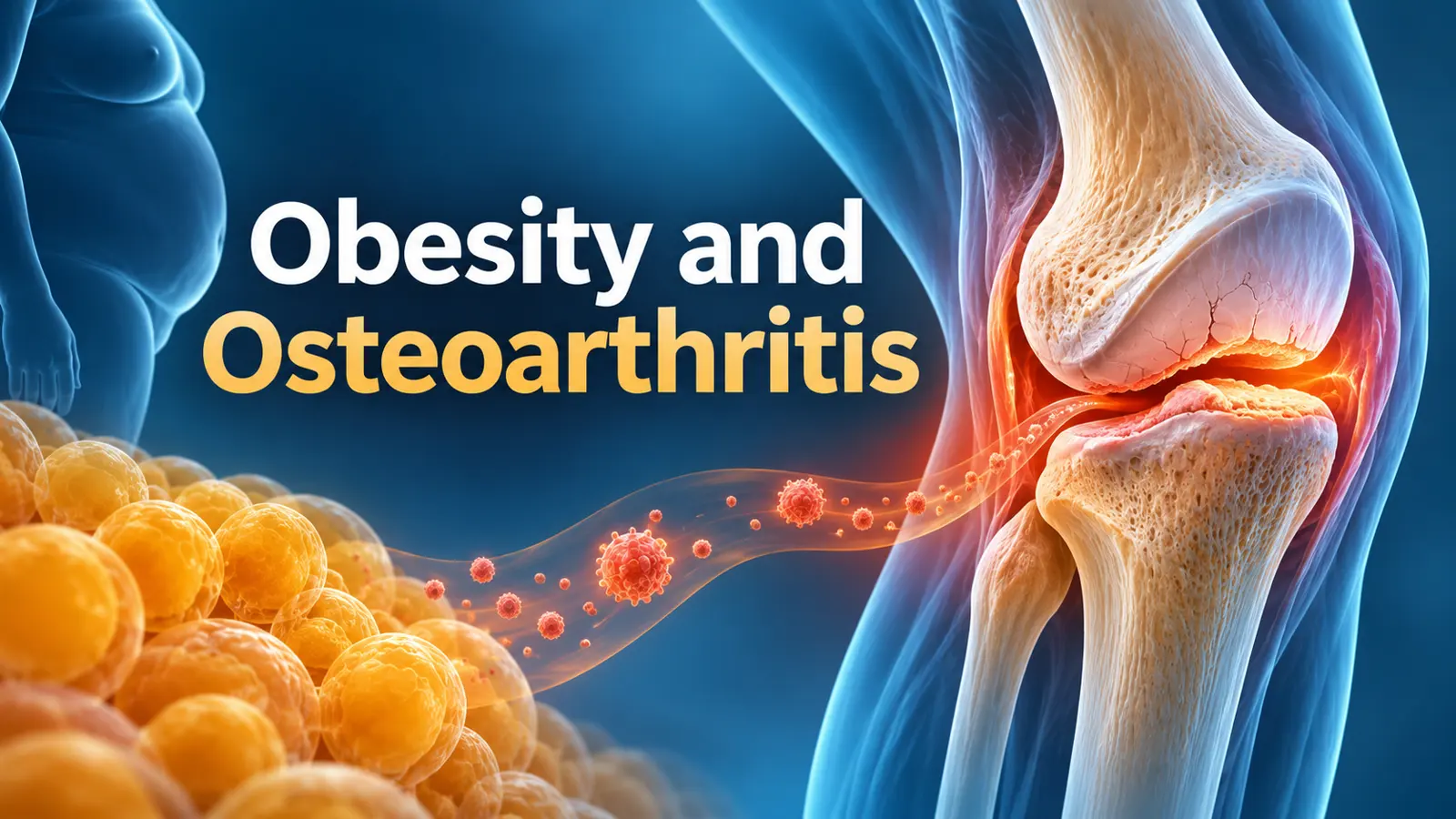
How excess adiposity relates to osteoarthritis through joint load and metabolic inflammation, with practical care options.
Obesity and Osteoarthritis
Osteoarthritis is often described as joint “wear and tear.” That phrase captures some of the effect of mechanical load, but it misses the biological role of adipose tissue. Excess adiposity may contribute to knee and hip symptoms through loading, altered movement, and inflammatory signaling. It does not follow that every person with obesity will develop osteoarthritis or that weight alone explains a painful joint. A useful plan examines the joint, function, metabolic risk and the person's goals together.
This article focuses on how adiposity and osteoarthritis interact. Our ABCD overview explains why fat-related complications matter beyond BMI. This guide goes deeper into one complication while avoiding the claim that losing weight is a complete treatment for all joint pain.
What is osteoarthritis?
Osteoarthritis is a joint condition involving cartilage, bone, synovium and surrounding tissues. It can cause pain, stiffness and reduced function. Symptoms often vary with activity and over time. An X-ray can show structural changes, but its severity does not always match pain. A person can have visible changes with little discomfort, or substantial symptoms with modest imaging findings.
The NIAMS osteoarthritis overview describes the condition and common management approaches. Diagnosis is based on history and examination, with imaging when useful. Do not assume that every knee pain episode in a person with a higher BMI is osteoarthritis. Injury, inflammatory arthritis, infection and other causes may require different evaluation.
How does body weight affect joints?
Walking and climbing stairs place repeated forces through the lower limbs. Additional mass can increase load on weight-bearing joints, especially the knee. Pain can then reduce activity, which may weaken muscle and worsen function. This cycle can make it harder to pursue weight or fitness goals. The answer is not to tell a patient simply to “move more” without addressing pain and safe progression.
Load is only part of the story. Joint alignment, previous injury, muscle strength, occupation and activity pattern also influence osteoarthritis risk. A lean person can develop severe disease, while a heavier person may remain mobile. Weight is one modifiable factor among several, not a moral judgment or a complete diagnosis.
Why does metabolic inflammation matter?
Adipose tissue is metabolically active. In excess or dysfunction, it can release signaling molecules associated with low-grade inflammation. Researchers are studying how these signals may affect joint tissues. One reason the question matters is that osteoarthritis can also occur in non-weight-bearing hand joints, where simple body-load explanations are insufficient. Yet translating a complex laboratory pathway into a guaranteed patient outcome would be premature.
The clinical implication is to consider metabolic health alongside joint care. Blood pressure, glucose, lipids, sleep and body composition may need review. Our normal-BMI metabolic risk guide shows why a normal weight category does not rule out risk. Similarly, a higher BMI alone cannot tell you the degree of joint inflammation.
Can weight loss help symptoms?
For people with excess adiposity and knee osteoarthritis, sustainable weight reduction can improve pain and function for some patients. The benefit varies, and joint damage may not reverse. Weight loss should be paired with activity and muscle preservation when appropriate. Very restrictive dieting that reduces strength can make movement harder. A clinician or dietitian can help choose a realistic goal and adequate nutrition.
Do not promise a specific percentage of pain relief or tell someone that surgery will never be needed if they lose weight. The decision depends on symptom severity, function, examination, imaging and response to nonsurgical care. A small improvement in walking tolerance is valuable even if the scale changes slowly. Track function as well as weight.
Strength training protects function
Muscles around the knee and hip help control movement and support daily tasks. A tailored strength programme can improve function without requiring high-impact exercise. Starting exercises might involve sit-to-stands, step-ups or resistance movements, adjusted for pain and ability. A physiotherapist can guide technique and progression. The American College of Rheumatology and Arthritis Foundation guideline supports exercise as a core management approach.
The goal is not to avoid all discomfort or to push through severe pain. Some temporary soreness with a new programme can occur, but persistent swelling or marked worsening should prompt adjustment. Our muscle and metabolic health guide explains why maintaining strength also supports ageing and glucose regulation.
What about walking and low-impact exercise?
Walking, cycling, swimming or other activity can support cardiovascular health and mobility. A person with knee pain may tolerate shorter, more frequent sessions better than one long walk. Footwear, surface and pacing can matter. A gradual increase gives tissues time to adapt. Exercise selection should reflect which joint is affected and any other health conditions.
Pain does not automatically mean that movement is damaging the joint. Equally, severe or new symptoms should not be ignored. If the joint is hot, very swollen, red, or accompanied by fever, seek medical assessment. A clinician may need to rule out infection or inflammatory disease before routine exercise advice applies.
Does every patient need an X-ray or MRI?
Diagnosis often starts with symptoms and examination. X-rays may help when the diagnosis is uncertain, symptoms are severe or treatment decisions depend on structural information. MRI is not required for every person with typical osteoarthritis. Imaging findings should be interpreted with the clinical picture. A report that says “mild arthritis” should not dismiss substantial pain, and a report that says “severe arthritis” does not by itself dictate surgery.
Ask your clinician what question the test will answer and how it could change treatment. Repeating scans frequently without a new clinical question may add little value. If symptoms change suddenly after an injury or the joint locks, the evaluation may differ from routine osteoarthritis care.
Medicines and injections have limits
Pain-relief medicines can help some patients participate in activity, but they have risks that vary with kidney function, blood pressure, stomach history and other medicines. Topical treatments may suit some joints. Injections may be considered for selected patients, with benefits and limits discussed. No product “rebuilds cartilage” reliably based on a short advertisement. Decisions should be individualized.
If joint pain prevents sleep or normal tasks despite an appropriate programme, discuss further options. Orthopedic assessment may be useful. Metabolic care remains relevant even if surgery is considered, because blood pressure, diabetes and fitness affect overall health and recovery. Avoid delaying specialist evaluation solely because a weight target has not been reached.
How ABCD frames the problem
Adiposity-based chronic disease focuses on the health effects of excess or dysfunctional adiposity rather than treating BMI as the whole diagnosis. Osteoarthritis can be one complication, but it is not proof of a single cause. A combined plan can assess joint symptoms, strength, fat distribution and cardiometabolic risk. The priorities differ between a person with mild pain and high diabetes risk and another with major mobility loss.
The plan should respect the patient's starting point. If walking hurts, begin with tolerable movement and support rather than an unrealistic step goal. If weight loss is appropriate, preserve nutrition and muscle. The most useful outcomes may include easier stairs, better sleep, improved blood pressure and the ability to remain active.
Frequently asked questions
Does obesity always cause osteoarthritis?
No. It can increase risk, but injuries, age, genetics and other factors matter. Some people without obesity develop osteoarthritis.
Is osteoarthritis only caused by joint load?
No. Mechanical factors matter, while adipose signaling and inflammation may also contribute. The exact contribution varies.
Can weight loss reverse cartilage damage?
It may improve symptoms and function for some people, but it should not be promised as a reversal of structural disease.
Should I avoid exercise if my knee hurts?
Usually a tailored activity plan is helpful, but severe or unusual symptoms need assessment. A physiotherapist can adapt exercise.
Is an MRI necessary before treatment?
Not always. Many cases can be evaluated clinically, sometimes with X-rays. Ask what information imaging would change.
Does normal BMI rule out joint-related metabolic risk?
No. Metabolic risk can occur at normal BMI, and joint symptoms require their own assessment.