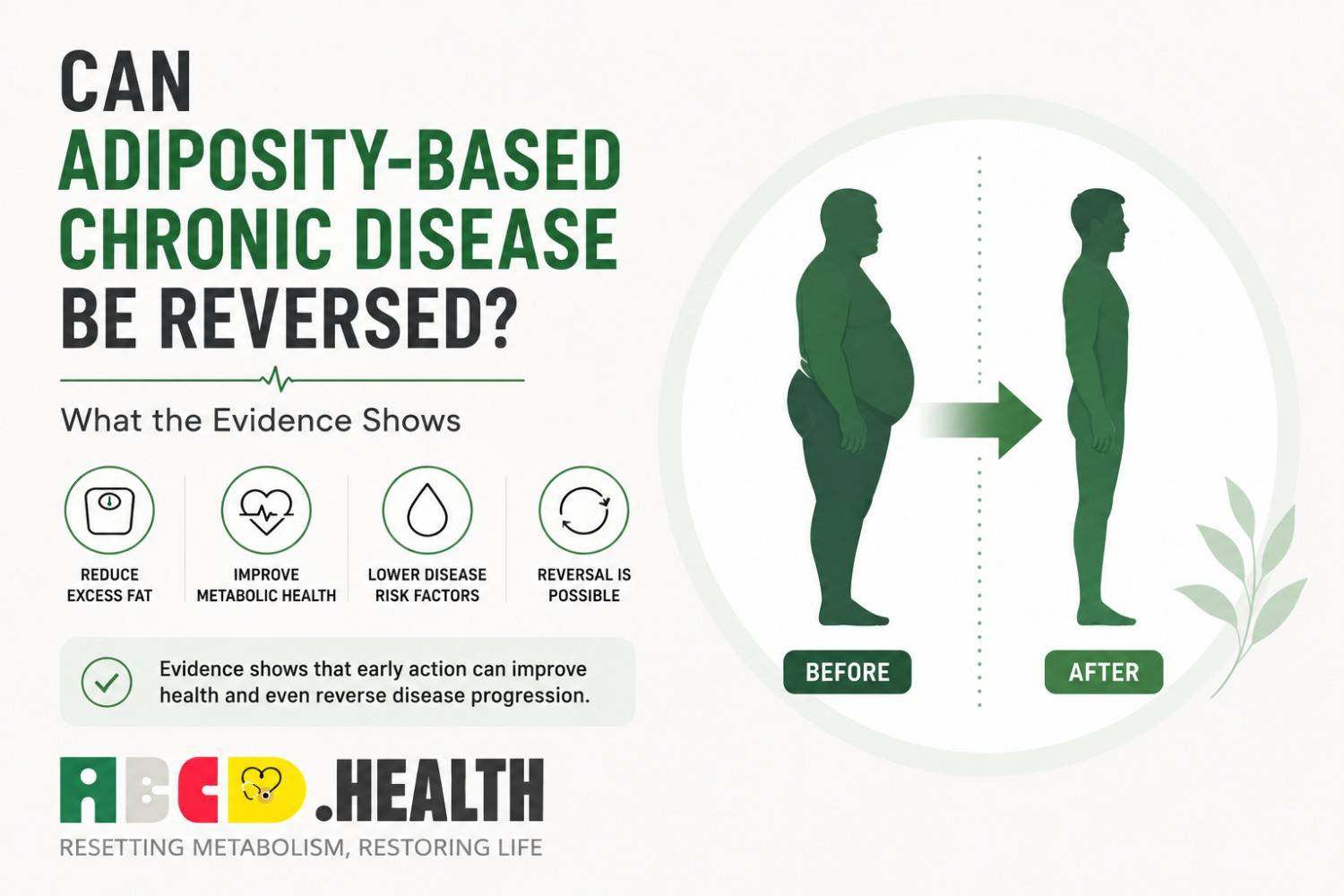
The honest answer depends heavily on stage. Here's what determines whether ABCD is fully reversible, partially reversible, or requires long-term management.
Can Adiposity-Based Chronic Disease Be Reversed? What the Evidence Shows
This is one of the most common questions patients ask once they understand that ABCD is a distinct diagnosis, not simply another word for being overweight. The honest, evidence-based answer is: often, yes, particularly at earlier stages, but the degree of reversibility depends heavily on how long the fat tissue dysfunction has been present and how many complications have already developed. It is not a simple yes or no.
What "Reversal" Actually Means in ABCD
Reversal doesn't necessarily mean returning to a specific weight or BMI. In the ABCD framework, reversal is measured primarily by improvement in fat tissue function and resolution of complications: normalising blood pressure, resolving prediabetes, improving or clearing fatty liver changes, and reducing markers of inflammation such as hs-CRP. Someone can meaningfully reverse their ABCD stage with a body composition change well short of reaching an "ideal" BMI, because the underlying goal is restoring metabolic function, not hitting an arbitrary number on a chart.
Reversal by Stage
As covered in our detailed guide to the four stages of ABCD, reversibility differs meaningfully by stage:
Stage 1 (adiposopathy without complications): Generally the most reversible stage. Fat tissue dysfunction at this point often responds well to sustained lifestyle intervention, with meaningful improvement in inflammatory and metabolic markers achievable within months.
Stage 2 (mild-to-moderate complications): Complications such as prediabetes, mild hypertension, and early fatty liver changes are frequently reversible with consistent treatment, though the timeline is typically longer and may benefit from medical therapy alongside lifestyle change.
Stage 3 (severe complications): Established conditions like type 2 diabetes or advanced fatty liver disease (NASH) may improve substantially, and in some cases go into remission, but full reversal to a disease-free state is less consistently achievable, and long-term management of at least some conditions is often still required.
What Actually Drives Reversal
Meaningful, Sustained Fat Loss
The research is consistent that the degree of fat loss matters for reversal, particularly visceral fat loss. A commonly cited threshold in research on metabolic improvement is roughly 5–10% total body weight loss to see meaningful improvement in blood pressure, lipids, and glucose control, with larger reductions producing progressively greater benefit, though the relationship isn't perfectly linear for every individual or every marker.
Preserving Muscle During the Process
Fat loss that comes disproportionately at the expense of muscle mass, whether through aggressive calorie restriction or rapid weight loss without resistance training, undermines the metabolic benefit even when the number on the scale looks favourable. Preserving lean mass supports the resting metabolic rate improvements that make reversal durable rather than temporary.
Time and Consistency
Fat tissue dysfunction that has been present for a decade generally takes longer to reverse than dysfunction caught within the first year or two, which is part of why early staging and early intervention, covered in our article on early signs of ABCD, meaningfully change the treatment timeline and likely outcome.
Medical Therapy Where Indicated
For Stage 2 and Stage 3 ABCD in particular, lifestyle change alone may not be sufficient, and evidence-based options including GLP-1 and other medications, as covered in our article on GLP-1 for ABCD, can meaningfully accelerate and deepen reversal when used as part of a supervised treatment plan.
What Doesn't Reliably Work
Rapid, unsupervised weight-loss approaches that aren't paired with resistance training and adequate protein intake often produce weight loss that looks impressive on the scale but disproportionately affects muscle, and are frequently followed by regain, per research summarised by bodies including the World Health Organization. Reversal that lasts requires a plan built around the specific stage and complications present, not a generic diet.
A Realistic Timeline for Reversal
Patients understandably want to know how long reversal actually takes, and while the honest answer is "it depends on stage and individual factors," a general pattern shows up consistently across treatment. In the first four to six weeks, changes tend to be subtle: early improvements in energy, sleep quality, and post-meal glucose response, often before significant weight change is visible. Between two and four months, more measurable shifts typically appear, improving fasting insulin, triglycerides, and blood pressure, alongside visible reductions in waist circumference. By six to twelve months of sustained treatment, many patients at Stage 1 or Stage 2 see their formal ABCD stage improve, with complications like prediabetes fully resolving in a meaningful proportion of cases.
For Stage 3 ABCD with more established complications, the timeline is typically longer, and the goal often shifts to substantial improvement and better disease control rather than complete resolution within the first year. Importantly, this timeline assumes consistent adherence throughout; inconsistent effort, common around holidays, travel, or high-stress periods, tends to stall progress rather than reverse it entirely, which is why building a sustainable routine matters more than short bursts of intense effort.
Frequently Asked Questions (FAQs)
1. Is partial reversal still clinically meaningful?
Yes, even partial improvement, such as normalising blood pressure while some insulin resistance remains, meaningfully reduces long-term disease risk and is a worthwhile outcome on its own.
2. What happens if I stop treatment once I feel better?
Stopping abruptly often leads to gradual regression toward the prior stage over months, since the underlying tendency toward fat tissue dysfunction doesn't disappear. A maintenance plan, even a lighter one, is generally recommended long-term.
3. Does age affect how well ABCD can be reversed?
Reversal is achievable at any age, though metabolic response can be somewhat slower in older adults. Age alone is rarely the limiting factor; stage and duration of disease matter more.
4. Is medication always needed for reversal?
No, particularly at Stage 1, lifestyle change alone is often sufficient. Medical therapy becomes more relevant as stage and complication severity increase.
5. Is ABCD always reversible?
Not always fully, particularly at Stage 3 with established complications like type 2 diabetes, but meaningful improvement is achievable at every stage, and earlier stages are generally more fully reversible.
6. How much weight loss is needed to reverse ABCD?
Research on metabolic improvement often cites roughly 5-10% total body weight loss as a threshold for meaningful improvement in blood pressure, lipids, and glucose, though this varies by individual and by which complications are present.
7. Can prediabetes from ABCD be fully reversed?
In many cases yes, particularly when caught early and addressed with sustained lifestyle change, and where needed, medical therapy. It is one of the more consistently reversible complications when addressed at Stage 2.
8. Does reversal require reaching a normal BMI?
No. Reversal is measured by improvement in fat tissue function and resolution of complications, which can occur with a body composition change well short of reaching a specific BMI target.
9. How long does reversal typically take?
This varies considerably by stage and individual, but meaningful improvement in inflammatory and metabolic markers is often seen within three to six months of consistent treatment, with continued improvement over a longer timeframe.
10. Can ABCD come back after being reversed?
Yes, if the underlying drivers, particularly weight regain and reduced physical activity, return. Reversal is best thought of as an ongoing state to maintain, not a one-time fix.
This article is for educational purposes and does not replace personalized medical advice. Please consult a qualified physician before making changes to your treatment, medication, or health screening plan.