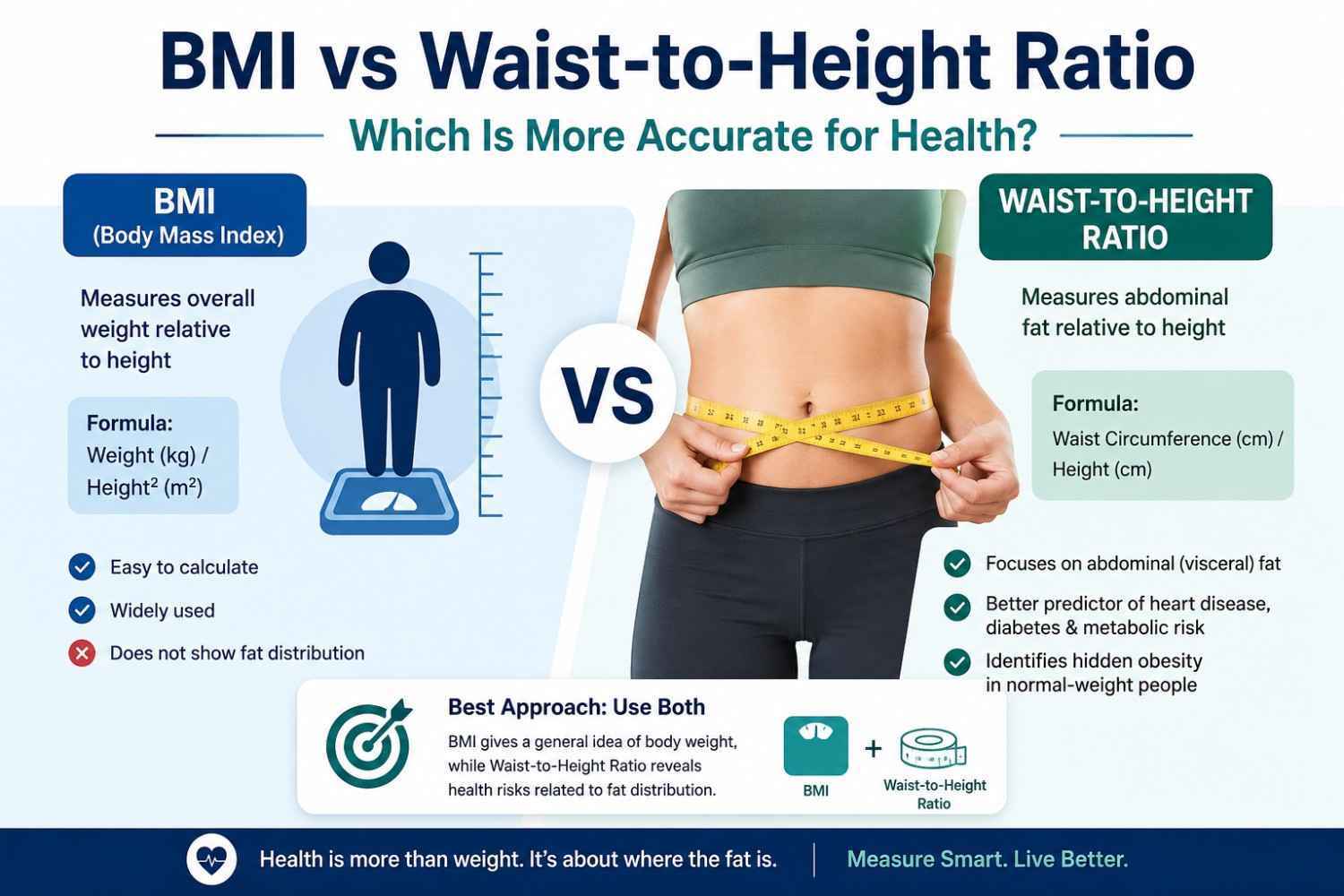
Compare BMI vs waist-to-height ratio to understand which method better predicts health risks and why fat distribution matters more than weight.
BMI vs Waist-to-Height Ratio: Which Is More Accurate for Health Risk?
When it comes to measuring health and obesity, most people rely on Body Mass Index (BMI). However, growing research shows that BMI alone may not provide a complete picture of your health. This has led to increased attention on alternative metrics like the waist-to-height ratio. If you are trying to understand BMI vs waist-to-height ratio, this guide explains which method is more accurate and why it matters for long-term health.
Obesity is not just about weight—it is about fat distribution, metabolic health, and associated risks. Modern approaches such as Adiposity-Based Chronic Disease (ABCD) recognize that understanding where fat is stored is often more important than simply measuring body weight.
What is BMI?
Body Mass Index (BMI) is a simple calculation based on your weight and height. It is widely used to classify individuals as underweight, normal weight, overweight, or obese.
- Underweight: BMI below 18.5
- Normal weight: BMI 18.5–24.9
- Overweight: BMI 25–29.9
- Obesity: BMI 30 or higher
Although BMI is convenient and widely accepted, it has several limitations. For a detailed explanation, read Why BMI Is Not Enough.
What is Waist-to-Height Ratio?
Waist-to-height ratio (WHtR) is calculated by dividing your waist circumference by your height. Unlike BMI, this measurement focuses on abdominal fat, which is one of the strongest indicators of metabolic disease.
A commonly accepted guideline is:
- Keep your waist circumference less than half your height.
- A waist-to-height ratio above 0.5 suggests an increased health risk.
Because it reflects abdominal fat, WHtR is often a better predictor of cardiovascular disease, diabetes, and metabolic syndrome.
Key Differences Between BMI and Waist-to-Height Ratio
1. Fat Distribution vs Total Weight
BMI measures body weight relative to height but cannot identify where fat is stored. Waist-to-height ratio specifically evaluates abdominal fat, which carries a much higher health risk.
2. Predicting Metabolic Disease
Research consistently shows that waist-to-height ratio is a stronger predictor of insulin resistance, heart disease, and type 2 diabetes than BMI alone.
3. Simplicity
Both methods are easy to perform. However, WHtR requires only a measuring tape and may provide more meaningful information without even using body weight.
4. Detecting Hidden Health Risks
BMI may classify someone as healthy despite excess visceral fat. Waist-to-height ratio can identify these hidden risks much earlier.
Why Abdominal Fat Matters More
Not all body fat behaves the same way. Visceral fat surrounds organs such as the liver and pancreas and actively contributes to inflammation, insulin resistance, and hormonal imbalance.
- Increases cardiovascular risk
- Raises the likelihood of type 2 diabetes
- Promotes chronic inflammation
- Contributes to metabolic dysfunction
These are some of the reasons why the ABCD model differs from traditional obesity classification.
Which Measurement Should You Trust?
The best approach is not to replace BMI but to use it alongside waist-to-height ratio.
- Use BMI for general population screening.
- Use waist-to-height ratio to evaluate abdominal fat and metabolic risk.
- Combine both with metabolic assessments for the most accurate evaluation.
Doctors may also recommend additional testing depending on your ABCD stage and overall metabolic health.
Limitations of Both Methods
Although waist-to-height ratio performs better than BMI in many situations, neither method tells the entire story.
Healthcare professionals may also evaluate:
- Body fat percentage
- Blood glucose levels
- Cholesterol profile
- Blood pressure
- Hormonal health
These factors are included during a comprehensive ABCD diagnosis.
How to Measure Waist-to-Height Ratio Correctly
To calculate your waist-to-height ratio:
- Measure your waist at the level of your belly button.
- Stand upright without pulling your stomach in.
- Divide your waist measurement by your height using the same units.
For example, if your waist measures 80 cm and your height is 170 cm, your waist-to-height ratio is 0.47, which falls within the recommended range.
Related Articles
- Why BMI Is Not Enough
- Obesity Is Not Just Weight: Understanding Metabolic Disease
- Adiposity-Based Chronic Disease: Causes, Symptoms, and Risk Factors
Final Thoughts
The comparison between BMI vs waist-to-height ratio reflects an important shift in healthcare. While BMI remains useful as a screening tool, waist-to-height ratio provides better insight into harmful fat distribution and metabolic risk.
Using both measurements together, along with a comprehensive metabolic assessment, offers a much clearer understanding of your overall health.
If you are concerned about your weight, waist size, or metabolic health, speak with a healthcare professional for a personalized assessment and an appropriate ABCD treatment plan.