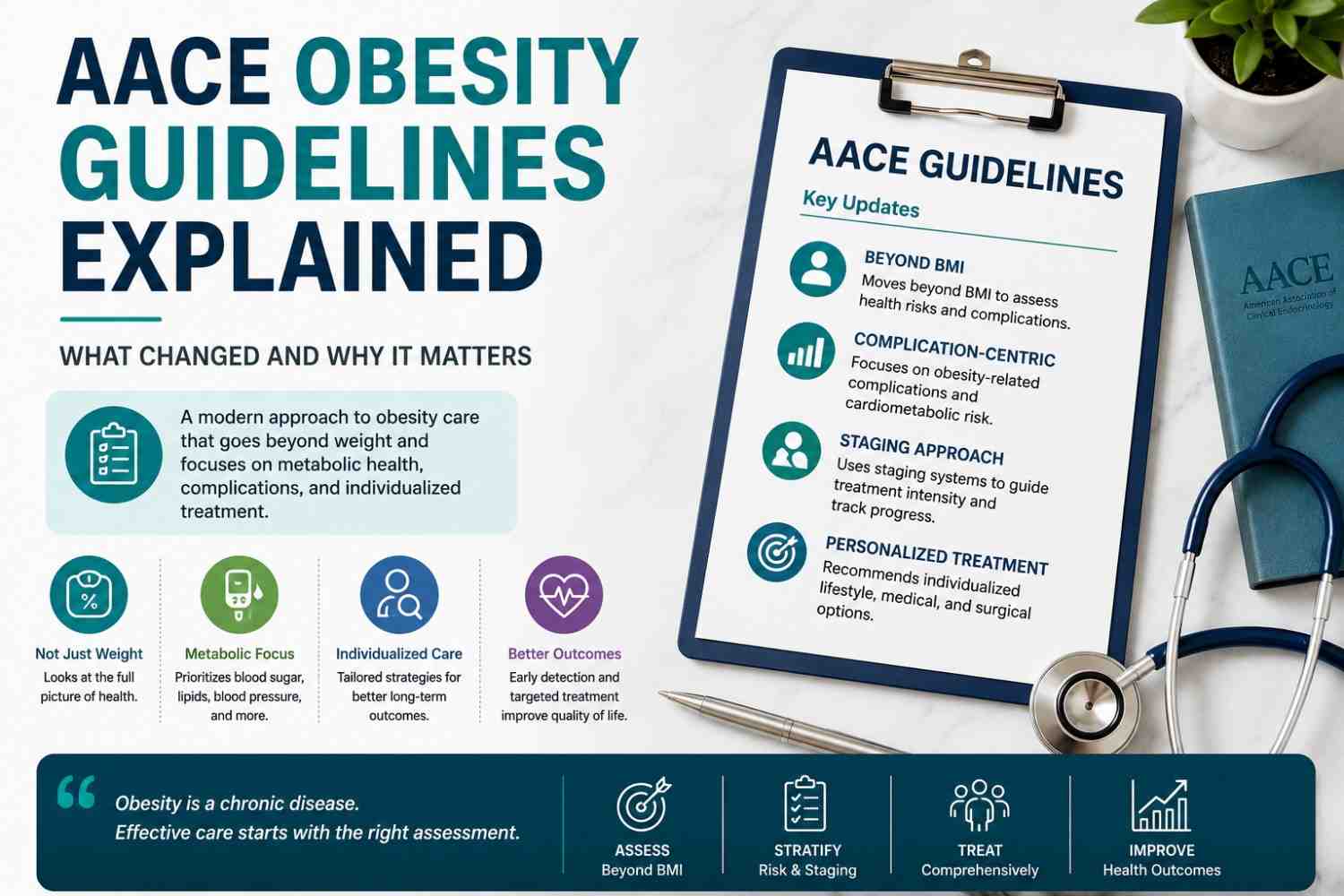
Understand AACE obesity guidelines, key changes from BMI-based assessment, and how modern obesity care focuses on metabolic health and complications.
AACE Obesity Guidelines Explained: What Changed and Why It Matters
Obesity care is no longer limited to simple weight-based definitions. Over the years, medical understanding has evolved, and so have the guidelines that shape clinical decisions. One of the most influential frameworks in this space comes from the American Association of Clinical Endocrinology (AACE). If you are trying to understand the AACE obesity guidelines, it is important to go beyond surface-level summaries and see what actually changed and why it matters in real-world health management.
These guidelines are not just for doctors. They impact how obesity is diagnosed, how risks are assessed, and how treatment plans are designed. More importantly, they shift the focus from weight alone to overall metabolic health, a concept that aligns closely with Adiposity-Based Chronic Disease (ABCD).
From Weight-Focused to Complication-Focused Care
Traditionally, obesity was defined using Body Mass Index (BMI). While BMI is simple and widely used, it does not reflect fat distribution, metabolic health, or disease risk accurately. The AACE guidelines challenge this limitation by moving toward a complication-centric approach.
Instead of asking only "How much do you weigh?", the new approach asks:
- Are there metabolic complications?
- Is there insulin resistance?
- Is abdominal fat affecting organ function?
- What is the patient's cardiometabolic risk?
This shift changes how obesity is understood and treated. It recognizes that two people with the same BMI can have very different health risks, which is also a core principle of ABCD versus traditional obesity.
Why BMI Alone Is No Longer Enough
BMI does not distinguish between muscle and fat, nor does it indicate where fat is stored. This is a major limitation because central or visceral fat is far more dangerous than fat stored elsewhere in the body.
The AACE guidelines emphasize the need for additional markers such as waist circumference, waist-to-height ratio, lipid profiles, and blood sugar levels. These metrics provide a more complete picture of metabolic health.
In simple terms, someone with a "normal" BMI can still be metabolically unhealthy, while another person with a higher BMI may not have significant complications. This is why BMI alone is no longer considered sufficient for assessing health risk.
The Role of Staging in Modern Obesity Care
One of the most important updates in the AACE approach is the use of staging systems. Instead of labeling someone as simply overweight or obese, patients are categorized based on the severity of their complications.
This helps in:
- Identifying early metabolic dysfunction
- Prioritizing high-risk patients
- Customizing treatment strategies
- Tracking disease progression over time
Staging allows clinicians to move away from one-size-fits-all treatment and toward personalized care.
How Treatment Recommendations Have Evolved
Treatment is no longer limited to "eat less and move more." The AACE guidelines promote a multi-layered approach that includes lifestyle, behavioral, and medical interventions.
Depending on the stage and risk profile, treatment may involve:
- Structured nutrition plans focused on metabolic health
- Exercise strategies tailored to insulin sensitivity
- Behavioral therapy to support long-term adherence
- Pharmacological treatment when necessary
- Bariatric procedures in severe cases
Patients with significant metabolic disease may also benefit from newer therapies such as GLP-1 treatment for ABCD, alongside long-term lifestyle management.
Why These Changes Matter for Patients
For patients, the updated guidelines mean better and more accurate diagnosis. Instead of being judged solely by weight, individuals are assessed based on their actual health risks.
This leads to:
- Earlier detection of metabolic problems
- More targeted treatment plans
- Reduced stigma around body weight
- Improved long-term health outcomes
It also helps patients understand that improving health is not just about losing weight but about improving metabolic function.
The Connection with Modern Frameworks Like ABCD
The AACE guidelines align closely with newer approaches such as Adiposity-Based Chronic Disease (ABCD). Both frameworks emphasize fat distribution, metabolic health, and complications rather than just body weight.
This connection is important because it shows a broader shift in medical thinking. Obesity is now viewed as a complex, chronic condition that requires a detailed and personalized approach.
What Still Remains a Challenge
Despite these improvements, there are still challenges in implementing the guidelines. Many healthcare systems continue to rely heavily on BMI due to its simplicity.
Other challenges include:
- Lack of awareness among patients
- Limited access to advanced diagnostic tools
- Time constraints in clinical practice
- Cost barriers for comprehensive treatment
Bridging this gap requires education, awareness, and better integration of these guidelines into everyday healthcare.
Practical Takeaway for Everyday Health Decisions
Even if you are not a clinician, these guidelines offer useful insights. You can start by focusing on metabolic health indicators rather than just body weight.
Simple steps include:
- Tracking waist circumference along with weight
- Monitoring blood sugar and lipid levels
- Improving diet quality rather than only reducing calories
- Incorporating regular physical activity
These actions align with the principles of the AACE guidelines and support better long-term health outcomes.
Related Articles
- What is Adiposity-Based Chronic Disease?
- ABCD vs Traditional Obesity
- Obesity Is Not Just Weight
- Why BMI Is Not Enough
- BMI vs Waist-to-Height Ratio
- GLP-1 Treatment for ABCD
Final Perspective
The AACE obesity guidelines represent a major shift in how obesity is understood and managed. By moving beyond BMI and focusing on metabolic health and complications, they provide a more accurate and effective framework for diagnosis and treatment.
This evolution is not just a technical update. It changes how patients are evaluated, how risks are identified, and how treatment plans are designed. As awareness grows, these guidelines are likely to play a key role in improving obesity care worldwide.
Understanding these changes can help you make better decisions about your health and approach obesity in a more informed and practical way.